
Aweh, Dear Ruminants and Groupies,
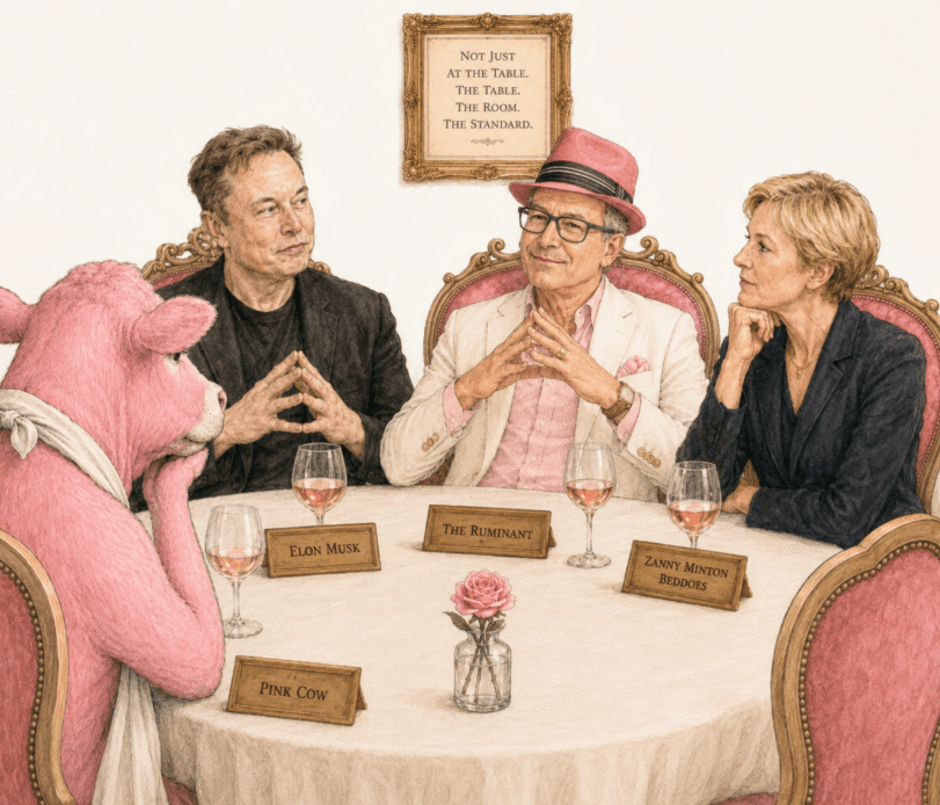
I watched all 85 minutes of the recent interview between Elon Musk and Zanny Minton Beddoes, editor-in-chief of The Economist.Not merely the flurry of soundbites it subsequently produced.
I had two reactions.
The first was:
Bloody hell, this is fascinating.
The second was:
Bloody hell, this is disturbing.
These reactions are not contradictory. Life would be much simpler if interesting people were reliably sensible and dangerous people reliably stupid. Unfortunately, reality has declined to arrange itself for our convenience.
Musk is unquestionably one of the most consequential people alive. He has helped transform electric vehicles, rockets, satellites and artificial intelligence. Anyone who dismisses him as merely a rich idiot is indulging in a comforting form of idiocy of their own.
But anyone who assumes that success in rockets confers omniscience in epidemiology, immigration, journalism and the future of Western civilisation may be indulging in an even more dangerous form of idiocy.
The interview left me thinking about objective reality.
More specifically, it left me wondering whether any of us has the faintest idea what objective reality is.
My reality is extremely objective
Most of us like to believe that we have a firm grip on reality. Other people have biases, ideologies, and algorithms whispering into their ears. I, by contrast, have facts.
Other people are manipulated by social media. I merely use it to stay informed. Other people cherry-pick evidence. I carefully select the evidence that happens to confirm what I already suspected.
This confidence is one of the more endearing features of the human animal.
I certainly like to believe that my view of the world is anchored in evidence. But I also know that I have a particular history, education, temperament, news diet and collection of prejudices.
I am not observing reality from a celestial platform above the clouds. I am peering through my own dirty little window.
The difficulty is that Elon Musk often appears to believe his window has been professionally cleaned by the universe.
The exhilarating Elon
The parts of the interview about artificial intelligence were extraordinary.
Musk predicted that AI could exceed the combined intelligence of humanity within roughly five years. Beyond that, he described a future in which AI and humanoid robots create such abundance that work becomes optional, and money eventually loses much of its meaning.
It sounds preposterous. It also does not sound entirely preposterous. That is the problem.
AI is advancing at a speed that should make any reasonably alert person alternate between excitement and the desire to hide under the bed.
Musk spoke about a future in which humans may no longer be the most intelligent beings on Earth. He seemed both exhilarated and terrified by the possibility.
He also suggested that the leading AI companies should inspect one another’s most advanced systems before releasing them. Coming from a man not generally associated with communal supervision or a modest assessment of his own wisdom, this was surprisingly reassuring.
But Musk’s predictions should always be handled with protective gloves. He has a long history of announcing technological arrival dates that reality subsequently treats as optional. This does not mean he is always wrong about the direction of travel. It means he is often spectacularly wrong about the timetable.
Perhaps that is part of his effectiveness. He announces an impossible future, forces thousands of people to organise themselves around it and sometimes produces something astonishing several years late. That is a very powerful industrial technique.
It is a less reliable method of discovering objective reality.
And then came zero
The interview became darker when the discussion moved to DOGE and the closure of USAID programmes.
Asked whether the sudden withdrawal of American aid had caused people to die, Musk’s answer was absolute:
Zero.
Not probably zero.
Not that the evidence was uncertain.
Not that reports of deaths had been exaggerated.
Zero.
The problem is that calculating the number of deaths caused by aid cuts is difficult. There is no celestial clerk stamping each death certificate:
Cause of death: USAID closure, 63%.
Researchers must estimate how many people would probably have survived if clinics had remained open, medicines had continued arriving, and health workers had stayed employed.
Such estimates contain assumptions and uncertainty. But “zero” is also a numerical claim. And it is a remarkably implausible one.
There have been credible reports of people dying after nearby health services closed. In South Sudan, Save the Children reported that eight cholera patients, including five children, died while walking for hours to reach treatment after aid cuts affected local services.
A major peer-reviewed study also projected that continuing the cuts could cause millions of additional deaths by 2030, including millions of children. A projection is not a body count. Models can be challenged. But uncertainty does not magically convert the answer into zero.
Musk’s response was that wealthy philanthropists could have replaced the funding and should therefore share responsibility.
This is an interesting moral manoeuvre. Imagine that I remove the fire extinguisher from a burning building and then announce that the neighbour had a perfectly good bucket.
The neighbour’s failure to arrive with the bucket may be regrettable. It does not prove that removing the extinguisher harmed nobody.
The fairest conclusion is therefore this: The exact death toll is uncertain. The claim of zero deaths is unsupported and contradicted by credible evidence of deadly disruption.
The mainstream media, whoever they are
Musk also launched into a familiar attack on “the mainstream media”.
There is a kernel of truth here. Trust in journalism is disastrously low. Media organisations have made serious mistakes. They travel in intellectual herds. They are vulnerable to political tribalism, commercial pressure and the assumptions of their own social class.
Journalists should not dismiss public distrust as evidence that the public is stupid. Musk is entitled to criticise them. But what exactly is “the mainstream media”?
Does it include The New York Times but exclude Fox News? Does it include the BBC but exclude a YouTuber with ten million subscribers? And surely it includes The Economist, whose editor was sitting directly opposite him?
Increasingly, “mainstream media” seems to mean:
Media that do not validate my version of reality.
There is another difficulty. Musk speaks as though he stands outside the media.
He does not.
He owns X, one of the most powerful information-distribution systems ever created. Its algorithms shape what hundreds of millions of people see.
Elon Musk is not outside the media establishment, bravely throwing stones at its windows. He owns part of the street, the window factory and the loudspeaker announcing which windows should be stoned.
The rhetoric of civilisational threat
Musk insists that he is defending safe cities, secure borders and Western values. None of those positions is inherently xenophobic.
Countries are entitled to control their borders. Immigration creates genuine pressures. Integration sometimes fails. Religious fundamentalism exists.
Pretending otherwise is not liberalism. It is denial. But xenophobia begins when foreigners are treated as a largely undifferentiated threat. It begins when the crimes of some become evidence against an entire group.
It begins when immigration, Islam, rape, murder and civil war are bundled together into one emotional package. Musk may sincerely believe he is defending Western civilisation.
I cannot see inside his soul, and I own no instrument capable of measuring the inner xenophobia of billionaires. But some of his rhetoric has a xenophobic effect.
It presents immigrants and Muslims less as diverse human beings and more as a hostile civilisational force. That story may contain some facts.
It may also profoundly distort reality.
Epistemic authority leakage
There is a pompous term for one of the traps involved here: epistemic authority leakage.
I admit that “epistemic authority leakage” sounds like something formulated by a committee of pink cows after a long lunch, three bottles of red wine and an unfortunate incident in a malfunctioning lift.
In plain English, it means this:
A person proves brilliant in one field, so we begin assuming they must be brilliant in all fields.
The great surgeon must understand economics.
The successful businessman must understand epidemiology.
The famous actor must understand vaccines.
The man who builds rockets must possess privileged knowledge of British Muslims, public health and journalism.
And I, having watched one long interview from the comfort of my bed, must apparently understand Elon Musk.
Human beings are bad at separating areas of expertise. We prefer whole heroes and whole villains.
Musk is therefore either a genius who must be trusted about everything, or a lunatic who has never achieved anything except being an autocrat and bullying engineers.
Both stories are childish.
He can be a remarkable entrepreneur who is also catastrophically overconfident outside his areas of expertise. He can be right about the direction of AI and wrong about USAID deaths.
He can identify real failures in immigration policy while exaggerating them into a story of civilisational collapse. He can correctly diagnose a crisis of trust in journalism while contributing to the information disorder that produced it.
Exceptional ability and catastrophic overconfidence can coexist in the same person.
Reality as a method
Perhaps objective reality is not something any of us possesses. Perhaps it is something we approach.
We approach it by testing our claims, distinguishing predictions from observations, changing our minds when evidence contradicts us, and accepting that uncertainty is not weakness.
The most disturbing feature of the interview was not that Musk and Beddoes saw the world differently.
That is normal.
It was the impermeability of his certainty. When challenged, his instinct was rarely to pause and ask whether he might be wrong. His instinct was to decide that the journalist was ignorant, the media were hated, and his own perception was correct.
That is not a firm grip on objective reality. It is a way of thinking in which nothing can ever prove you wrong.
For most of us, this merely turns Christmas lunch into a six-hour hostage situation involving cold turkey, warm wine and a drunken uncle shouting about vaccines.
When it belongs to a man who controls rockets, satellites, AI systems, a major communications platform and an unimaginable amount of capital, it matters rather more.
Musk may be right that AI is about to transform civilisation. But children still require medicine today. Clinics still exist in the physical world.
Immigrants are not a single organism. And “zero” does not become objective reality simply because Elon Musk says it with extraordinary confidence.
One can help build the future and still bullshit about the present.
Until next time.
Bruce

