
Aweh Dear Ruminants and Groupies,
Last week I wrote about foreigners and immigration. This week is a continuation of that discussion, although it takes what appears to be a rather odd detour into artificial intelligence and how I think. Bear with me. There is a point to all of this. At least I hope there is. Otherwise, you’ve just wasted five minutes of your life, and I’ve wasted considerably more writing it.
Let me begin by repeating the opening paragraph from last week’s blog.
The American columnist David Brooks has observed that many people seem remarkably uninterested in the hard work of thinking, finding it far easier to outsource that burden to whoever offers the simplest explanation.
Today, of course, you don’t even need another person. AI is more than happy to do your thinking for you.
But what about those of us who actually enjoy thinking? I’d like to believe I’m one of them. The alternative is too ghastly to contemplate.
So how do I think?
The foundation is reading. Lots of it. Decades of it. Almost entirely non-fiction.
I have a restless, curious, and thoroughly disorganised mind. Reading fills it with ideas, but it doesn’t organise them.
Writing does.
I write. Then rewrite. Then rewrite again. Eventually, I publish my thoughts here and elsewhere, inviting criticism. If nobody objects, I become more provocative. Thinking, for me, requires friction.
Over the past four years, I’ve also found myself back in the classroom, teaching subjects I knew reasonably well but was certainly not an expert in. Preparing for those classes forced me to think harder than I had in years.
Then came the students.
Many approach the world from a perspective shaped by statism and perspectivism. The state is assumed to be the primary solution to most social problems, while objective truth itself is often treated with suspicion. Knowledge becomes something negotiated rather than discovered. Reality is less something to be understood than something to be interpreted.
Whether they’re right or wrong is almost beside the point.
Being challenged by people who begin with fundamentally different assumptions has forced me to examine my own. Some of my views have become stronger. Others have changed. Either way, the exercise has been invaluable.
Good thinking needs resistance.
Which brings me to AI.
I use it every day.
Has it made me lazy?
Only if I let it.
An Experiment
Rather than tell you what I think about immigration, let me show you how I think.
Or, more accurately, let me show you how I argue.
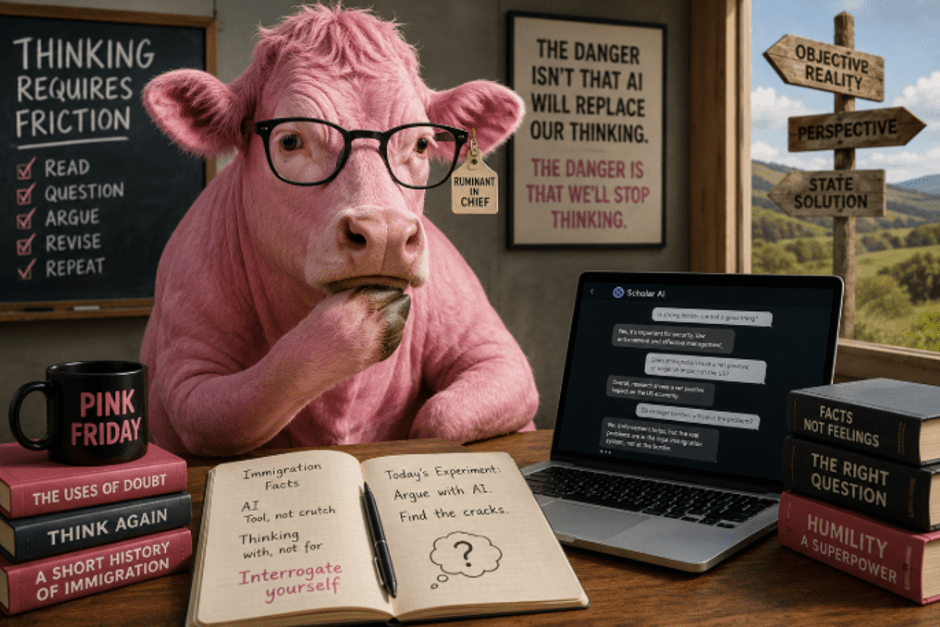
I asked Scholar AI a deliberately loaded series of questions.
It began by saying that strong border control is important because it helps countries protect their security, enforce their laws, and manage immigration effectively.
I then asked whether immigration had been good or bad for the United States.
It summarised the research: overall, immigration has been a net positive, contributing to economic growth, entrepreneurship, innovation, and addressing labour shortages.
Next, I asked about the history of border controls. It pointed out that modern immigration controls are surprisingly recent, becoming widespread only in the late nineteenth and early twentieth centuries.
I then asked the obvious follow-up.
If immigration has generally benefited the United States, should America simply strengthen border controls and reduce immigration?
Its answer changed.
The strongest evidence, it said, supports effective border enforcement alongside a robust, well-managed legal immigration system—not broadly reducing immigration itself.
I pushed further.
If legal immigration is already declining and the current system is widely regarded as dysfunctional, will stronger border controls solve the problem?
“No,” it replied. Border enforcement may reduce illegal crossings, but it does nothing to fix visa backlogs, immigration courts, or administrative failures.
Finally, I accused it of contradicting itself.
Its response was fascinating.
It admitted that its initial answer had been incomplete and refined its position considering the broader evidence.
Now, was the AI biased?
Probably.
Was I biased?
Without question.
My questions were deliberately designed to expose weaknesses. I wasn’t looking for agreement. I was looking for cracks.
And that’s what struck me.
The contradiction wasn’t really the AI’s. It was mine.
By changing the framing of the questions, I exposed the limitations of the original answer. In doing so, the AI did something many humans struggle to do. It revised its position without becoming defensive.
That is where AI becomes genuinely useful.
Not because it thinks for me.
Because it thinks with me.
Used badly, AI becomes the world’s fastest confirmation-bias machine. It will happily reinforce whatever you already believe.
Used well, it becomes an argumentative colleague with infinite patience. It lets me test assumptions, probe evidence, refine arguments, and, occasionally, discover that the flaw wasn’t in the answer but in the question I asked.
That, I think, is the real lesson.
The danger isn’t that AI will replace human thinking.
The danger is that we’ll stop interrogating our own assumptions and simply accept the first plausible answer, whether it comes from a politician, a television commentator, a university lecturer, or a chatbot.
Thinking has always required friction.
AI doesn’t remove that requirement.
If anything, it makes it more important.
Anyway, I’ve now spent a thousand words arguing that people should think more while admitting that I spend a fair portion of each day arguing with a machine. The machine occasionally gives me poor answers. More interestingly, it occasionally exposes weaknesses in my own questions. Which is more than can be said for many conversations on social media or, if I’m being completely honest, for me on a Friday.
So perhaps the lesson is this: don’t trust AI.
Interrogate it.
More importantly, interrogate yourself.
Until next week,
Bruce

