
Aweh, Dear Ruminants and Groupies,
The American columnist David Brooks has observed that many people seem remarkably uninterested in the hard work of thinking, finding it far easier to outsource that burden to whoever offers the simplest explanation.
Thinking requires holding contradictory ideas simultaneously. It requires tolerating uncertainty. It requires sitting with the discomfort that complex problems may not have satisfying solutions. Students ask me how we solve climate change. What is the answer? There is no easy answer. If you don’t want to think and want a simple answer, listen to Donald Trump. Climate change is a hoax. If that works for you, it might be better for you to skip this blog.
Most of all, thinking requires resisting the intoxicating relief of having someone else think on our behalf.
This may be one of the great political vulnerabilities of the twenty-first century. We have become increasingly happy to outsource our thinking.
Enter Nigel Farage.
Enter Donald Trump.
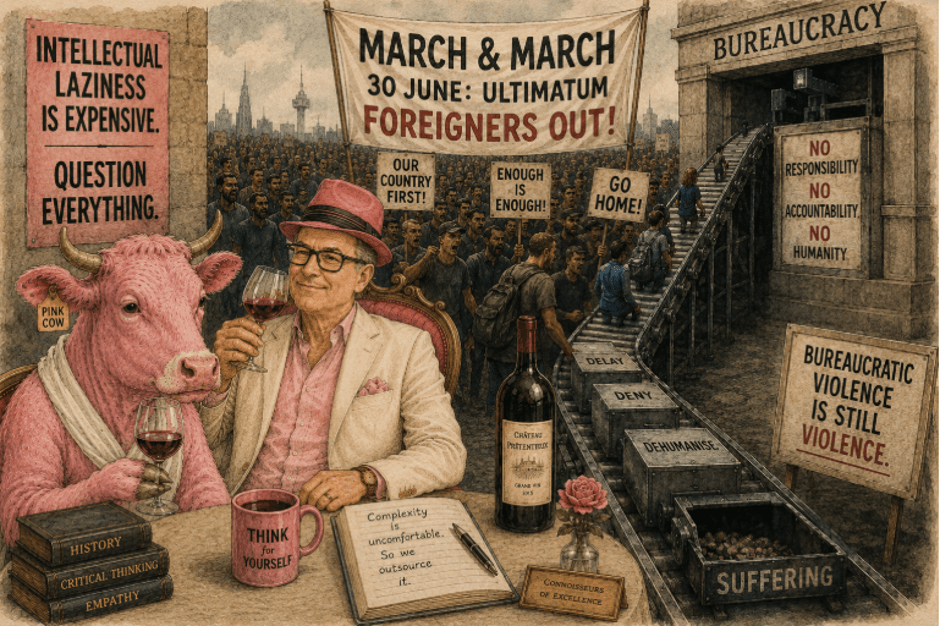
Enter March & March, led by Jacinta Ngobese-Zuma
March & March is a hardline anti-immigration movement demanding the summary removal of undocumented migrants from South Africa. It has gained attention through confrontational protests, ultimatums and nationalist rhetoric, arguing that immigration is a major driver of the country’s social and economic problems.
Enter every politician who has ever discovered that a frightened public can be persuaded that social decline has a face, an accent, and a foreign passport. It is a remarkably efficient transaction.
Citizens surrender complexity. Politicians provide certainty. Everyone walks away temporarily satisfied.
A country is struggling? Foreigners.
Public services are collapsing? Foreigners.
Unemployment? Foreigners.
Housing is unaffordable? Foreigners.
Crime is increasing? Foreigners.
The exchange is almost elegant in its simplicity. The less one thinks, the more convincing it becomes. This is not a uniquely South African pathology. It is an international one. South Africa merely performs its own version of a now-global script.
Britain has Nigel Farage standing on the shoreline, warning of boats crossing the English Channel. America has Donald Trump transforming immigration into a permanent spectacle and turning Immigration and Customs Enforcement (ICE) into a cultural symbol of patriotic aggression rather than an administrative agency.
On 30 June, March & March and allied groups are planning nationwide protests and a possible shutdown after issuing an ultimatum demanding that undocumented migrants leave South Africa and that government intensify immigration enforcement, despite having no legal authority to impose such a deadline.
The details vary. The choreography does not. Governments fail. Institutions decay. Public anger grows. And politicians discover that it is much easier to identify a villain than to repair a system.
Because systems are boring. No one wants to protest outside a procurement office. No one marches against administrative incapacity. Nobody creates viral social media content demanding improved interdepartmental coordination. Institutional failure is catastrophically uninteresting.
Foreigners, however, possess a certain theatrical utility. They can be made to carry almost any burden a society wishes to avoid confronting itself.
And so we march.
And march.
And march.
What often disappears from these conversations is the role of bureaucracy itself. The phrase “bureaucratic violence” sounds abstract, almost academic. It sounds like something a sociologist might mutter at a conference before everyone politely moves on to lunch.
But bureaucratic violence is not abstract. It is violence. It sullenly sits behind a counter. It occurs when states use administrative systems to inflict suffering while preserving the illusion that no one is responsible. No one strikes a blow. No one raises a fist. No one appears to be committing an act of aggression. Instead, a website crashes. An application disappears. A permit expires. An appeal is never heard. An office cannot be reached. A queue begins at four in the morning. A family waits for years in uncertainty. Children grow up not knowing whether they belong.
Lives are suspended indefinitely because a government cannot perform basic administrative tasks. The violence lies precisely in its invisibility. Nobody has to say, “We intend to harm these people.” The harm simply accumulates. One form at a time. One delay at a time. One missing signature at a time.
Bureaucratic violence is especially dangerous because it allows everyone involved to maintain a sense of innocence.
Politicians blame administrators. Administrators blame regulations. Departments blame budget constraints. Citizens blame migrants. And the machinery continues to operate while responsibility evaporates into the air.
The Zimbabwe Exemption Permit saga illustrates this perfectly.
Hundreds of thousands of Zimbabweans who lived, worked and paid taxes in South Africa found themselves trapped inside a revolving door of deadlines, policy reversals, court interventions and legal ambiguity.
Their lives became contingent on the mood swings of an administrative state that frequently appears unable to interpret its own rules. One day legal. The next day, perhaps not. Then temporarily legal again. Then, awaiting clarification. Then, awaiting another clarification of the clarification.
The question is not simply whether states administer immigration competently. It is whether we have become so attached to borders that we no longer recognise the absurdity of organising human belonging around documents that governments themselves cannot reliably produce, interpret or maintain.
Yet we continue to speak about “legal” and “illegal” migration as though these are stable categories engraved into stone tablets somewhere inside the Department of Home Affairs.
This is nonsense.
The categories themselves have become unstable because the institutions responsible for producing them have become unstable. But acknowledging this would force us to think. And thinking is precisely what modern politics increasingly encourages us to avoid.
Thinking requires us to ask awkward questions. Why are municipalities collapsing? Why have economic opportunities stagnated? Why do hospitals struggle? Why do schools fail so many children? Why do states across the world appear increasingly incapable of administering themselves? Those questions lead us somewhere uncomfortable. They lead us away from migrants.
The answers do not point to a single cause or a single villain. They lead us instead into a dense web of economics, politics, institutional decay, corruption, historical legacies, technological change, and our own susceptibility to simple explanations.
It implicates citizens who have become so exhausted by complexity that they willingly outsource their thinking to anyone offering certainty.
That is the real danger of our age. Intellectual surrender. The agreement we make with demagogues. You tell me who to blame, and I will stop asking questions.
Farage understands this bargain.
Trump understands this bargain.
And in South Africa, we have Jacinta Ngobese-Zuma
They understand that you do not need to solve a problem if you can narrate it differently. You only need to persuade people that decline has a face. Someone who arrived from somewhere else.
The tragedy is that this bargain never produces solutions. It produces anger that seeks a target, resentment that hardens into prejudice, and prejudice that gradually becomes dehumanisation. Once a society has accepted that some people are primarily a problem to be removed, imprisoned and deported rather than fellow human beings, the descent can be alarmingly quick. Bureaucratic exclusion gives way to social exclusion, social exclusion normalises violence, and history reminds us that, in its darkest iterations, such politics have ended in ethnic cleansing and genocide.
All while the institutions responsible for our collective decline continue to crumble in plain sight. There is perhaps no greater expression of intellectual laziness than this: a society capable of recognising its own suffering yet unwilling to investigate its causes.
We prefer villains to systems. Certainty to complexity. Outrage to thought.
And so we march.
And march.
And march.
Past the broken institutions. Past the unanswered questions. Past the machinery of bureaucratic violence itself.
Towards what destination, nobody seems entirely sure.
But at least we no longer have to think.
Bruce


10/10 The truth absolutely brilliantly said Bruce
LikeLike