
Aweh, Dear Ruminants and Groupies
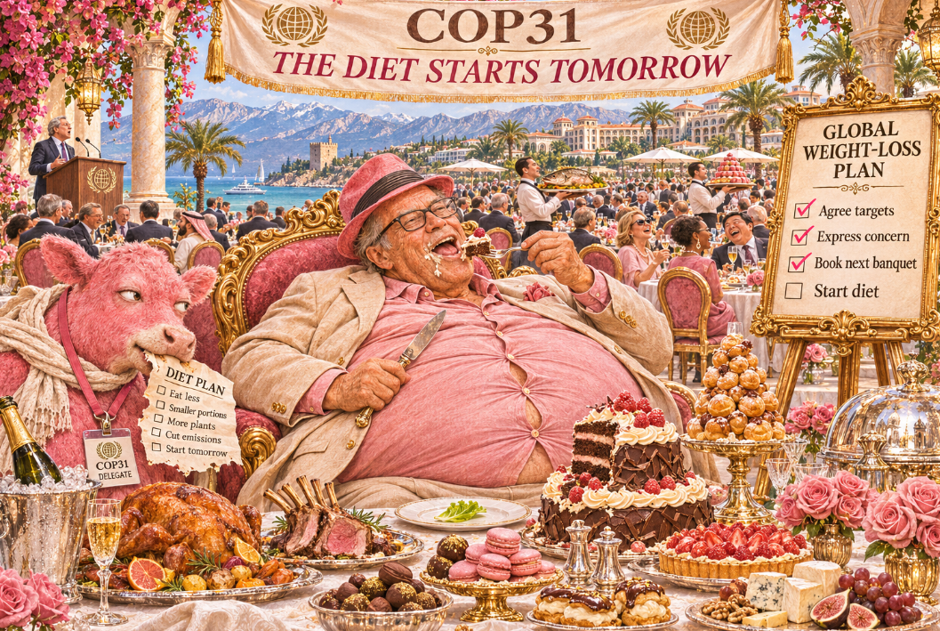
Imagine humanity as a dangerously overweight billionaire who has received some thoroughly unpleasant results from his doctor. The diagnosis is clear. The underlying mechanisms are understood. Continuing as before will have consequences.
He responds by inviting approximately 100,000 people to a beautiful Mediterranean holiday destination to discuss healthy eating.
Welcome to COP31.
The actual setting is Antalya, Türkiye, and the anticipated scale comes from a UNFCCC briefing. The banquet is my metaphor, although you must concede that the organisers have provided an exceptionally accommodating setting for it.
Picture the proceedings. Between courses, delegates discuss humanity’s diet and exercise regimen. Everyone agrees that obesity is an existential threat. Everyone supports ambitious weight-loss targets and an exercise regimen. Difficulties arise when the discussion turns to whose pudding will be confiscated.
After exhausting negotiations, an agreement recognises the urgent need to transition away from second helpings, taking account of national circumstances.
Applause. Coffee. A wafer-thin mint.
Thirty-one. Count them.
COP stands for Conference of the Parties. This is the thirty-first instalment.
Thirty-one is an impressive number. By your thirty-first meeting with a personal trainer, you might reasonably expect a conversation about why your trousers still don’t fit.
Instead, we have humanity’s annual New Year’s resolutions. This year we will eat sensibly. This year we will exercise. This year we will finally become the responsible species described in the executive summary.
There is something intensely human about this. Announcing an intention feels good. Buying the running shoes feels good. Creating a spreadsheet of your future athletic achievements can occupy a very satisfying afternoon.
Running is considerably less pleasant.
The trouble is that the patient does not merely enjoy pudding. He owns the pudding factory, employs several million people making pudding, and has borrowed heavily against the assumption that pudding consumption will continue indefinitely.
Our climate resolutions have developed rather further than the average abandoned gym membership. They have acquired institutions, professional networks, exhibition stands, communications teams and an elaborate calendar of preparatory meetings.
We now have an entire apparatus for preparing to announce what we intend to do.
Somewhere in the distance, the treadmill waits.
The diet finally works when the kitchen catches fire
The latest Global Carbon Budget projects a modest 0.4% decline in global fossil carbon dioxide emissions in 2026. Expansion of clean energy contributes, but an important driver is the oil shock associated with the Iran conflict: disrupted supplies and higher prices suppressing consumption. Oil emissions are projected to fall by 1.9%.
There have been temporary emissions declines before. The unresolved question is whether we have finally entered a sustained descent, rather than another interruption.
Still, savour the grotesque irony.
Thirty-one conferences into humanity’s organised expression of concern, part of this year’s improvement arrives courtesy of war making fuel harder to obtain and more expensive to burn.
This is an observation about the species, not a recommendation for its foreign policy.
We can explain the problem. We can model it. We can produce exquisitely coloured charts describing what happens if we fail to address it. But making consumption physically difficult or financially painful appears to command a more immediate response than another eloquent invitation to behave responsibly.
Our patient has lost a little weight. Unfortunately, this is partly because something dreadful happened to the catering arrangements.
COP what?
Try a small experiment. Ask someone outside the climate and energy world what COP31 is.
Perhaps they know. Perhaps they remember something about a previous one in Dubai. Perhaps they assume it is a particularly disappointing sequel to a police film.
I have no survey establishing how many people know or care. But it is worth contemplating how an event can dominate the lives of its participants while barely entering the consciousness of the people on whose behaviour its ambitions depend.
Outside the conference, people are getting children to school, worrying about work and calculating whether they can afford the next electricity bill. In Johannesburg, some are wondering whether electricity will arrive at all.
They may care about climate change. That does not mean they are following the negotiations over paragraph seventeen.
Inside the room, the wording is historic.
Outside, someone needs petrol.
Sincerity is not the missing ingredient
It would be comforting if the whole thing could be explained by hypocrisy. Identify the frauds, expose the private jets, make a few jokes about the buffet and go home feeling superior.
Unfortunately, many participants will be sincere, knowledgeable and working very hard. Useful negotiations occur. Agreements matter. A global problem does require cooperation.
That makes the spectacle more unsettling.
A system does not need to be populated by fools to produce absurdity. It can contain intelligent people doing individually defensible things while collectively failing to achieve anything resembling the necessary result.
One person negotiates. Another researches. Another raises awareness. Another secures funding to continue raising awareness. Everyone has deliverables. Everyone is busy.
The conference ends with enough progress to justify continuing and enough failure to make the next conference indispensable.
It is an extraordinarily durable arrangement.
The atmosphere, regrettably, cannot distinguish between a ton of carbon dioxide emitted by someone who cares deeply and one emitted by someone who thinks the entire business is a Chinese conspiracy.
Sincerity does not appear in the equation.
The Ruminant orders coffee
At this point, the conventional article produces a list of recommendations. Smaller conferences. Better accountability. More implementation. Fewer speeches.
I shall spare you my contribution to the global inventory of sensible proposals.
The science is serious. The consequences are serious. That is what makes the recurring pageant so bleakly funny. We possess an extraordinary capacity to understand what we are doing, accompanied by a rather less impressive capacity to stop doing it.
And here I sit, comfortable, educated and sufficiently insulated from immediate hardship to find the whole thing darkly entertaining.
I have written a blog.
This allows me to enjoy the satisfaction of having identified the absurdity without suffering the inconvenience of becoming substantially less absurd myself. Retirement approaches. There are places I would like to visit. Flights will presumably be involved.
The delegates have their declarations. I have my paragraphs. Both provide a pleasing sense of participation.
I finish writing and turn to something more immediately rewarding: the next trip, perhaps, and somewhere pleasant to have lunch.
The diet starts tomorrow.
There is still dessert.
Until next time
Bruce

