
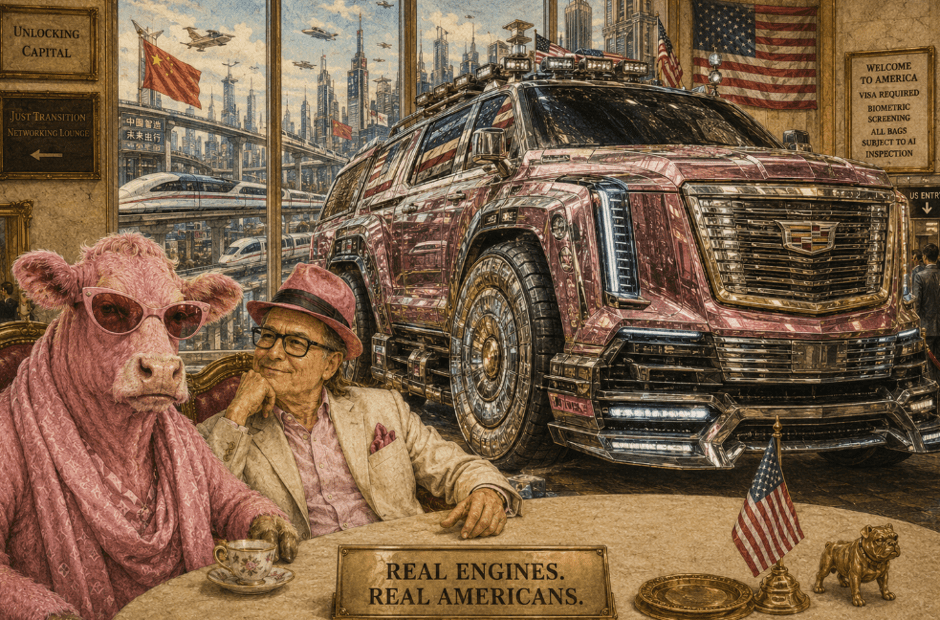
Aweh, Dear Ruminants and Groupies,
It is September 2046 and I am going to America.
I have been advised not to. Not because it is dangerous. America remains quite safe, provided one avoids schools, political rallies and discussing tariffs.
The problem is getting in.
My American visitor visa cost $10,000. There were three interviews. The first established why I wanted to visit America. The second established why America should want me to visit America. The third appears to have established whether I had lied during the first two.
I was required to provide twenty years of social-media history, proof of assets, tax returns, fingerprints, a retinal scan and the names of everyone I have met since 2017 who may have expressed an unfavourable opinion about the United States.
Eventually I hired a US Immigration Facilitation Consultant. She charged $2,800 and successfully uploaded Form DV-447B after I repeatedly failed the section asking whether I had ever advocated replacing an internal-combustion engine with an electric motor.
Three months later:
VISA APPROVED.
Welcome to America.
President Trump welcomes you
Barron Trump is President.
Not Donald. Barron.
President Barron William Trump, 40 years old, is serving the second year of his first term after campaigning on the slogan:
AMERICA: STILL GREAT. STILL OURS.
His inauguration was held inside the newly constructed Donald J. Trump Capitol Complex, decorated with three tons of real gold.
There are tariffs on almost everything.
Chinese cars: 300%. Chinese batteries: 250%. European cars: 100%.
Foreign steel: complicated. French cheese: punitive. South African wine: under review.
The justification remains national security. Almost everything is now a national-security issue.
The remarkable thing is that the rest of the world has largely stopped arguing.
It has moved on.
Getting anywhere else
Two weeks earlier I had travelled to Shanghai. My Chinese visa took eleven minutes. I photographed my passport, answered six questions, paid $38 and received a digital authorisation while making coffee.
The Australian one took four minutes. Britain knew who I was before I did.
South Africa, remarkably, has finally managed an electronic visa system, although the Department of Home Affairs website still warns that it works best with Internet Explorer.
International travel in 2046 has become extraordinarily easy.
Except to America.
America has spent twenty years building a wall. The clever bit is that much of it isn’t on the Mexican border.
Shanghai
Shanghai is staggering. It is now unquestionably one of the capitals of the world.
Not an emerging superpower.
The superpower.
China overtook the United States economically years ago and, more importantly, much of Asia, Africa and Latin America now trades more with China than with America.
The renminbi hasn’t completely replaced the dollar. History is seldom that tidy. But nobody automatically asks what Washington thinks anymore.
That is the real change.
The airport is vast, automated and unnervingly efficient. I walk through immigration without speaking to anybody. My taxi recognises me from the booking. There is no driver. There is also no engine.
Almost nothing has an engine.
BYD still exists, although after several mergers it is part of some enormous industrial group with a name resembling an internet password. Geely is everywhere. Xiaomi makes cars, domestic robots and something apparently called a Personal Atmospheric Mobility Device.
The cars are astonishingly cheap.
And nobody calls them EVs.
They call them cars.
London
London feels older, poorer and rather charming after Shanghai. Europe did not win the 21st-century automotive war.
But it survived it.
Volkswagen still exists. So do BMW and Mercedes. Stellantis underwent another seven mergers and is now called Stellantis-Renault-Bosch-Mobility Europe SE, which nobody can remember.
Europe spent the 2030s painfully restructuring. Factories closed, governments panicked, unions marched and Brussels produced several million pages of regulations.
And then European companies did something radical.
They competed.
Chinese manufacturers built factories in Europe. European manufacturers bought Chinese batteries and software. Chinese companies bought European brands. Eventually nobody could tell what nationality a car was.
It didn’t matter.
London is quiet. The air is clean. Cars are relatively small.
And then I fly to Johannesburg.
Johannesburg
South Africa has also electrified. Obviously, we did it completely differently.
There was a National Electric Mobility Strategy. Then a revised strategy. Then a Green Transport Roadmap. Then a Just Electric Mobility Transition Framework.
Then somebody discovered that Chinese companies were already selling the cars.
So, we bought them.
This proved considerably more effective.
By 2046 BYD and Chery are simply ordinary South African brands. Toyota remains huge. So does Volkswagen. There are Chinese electric bakkies, Japanese hybrids, Korean EVs and elderly German cars held together by independent mechanics in Wynberg.
Johannesburg electrified surprisingly quickly because Eskom accidentally prepared us for it. Twenty years of unreliable electricity persuaded middle-class South Africans to install solar panels, batteries and inverters.
We inadvertently constructed millions of private charging stations.
The state subsequently claimed this as a successful policy intervention.
On the M1 my autonomous electric taxi overtakes a 2006 Hilux. It is smoking and has 740,000 kilometres on the clock.
It may be the most reliable object ever manufactured by humanity.
Sydney
Sydney is Shanghai with rugby, beaches and enormous bakkies.
Australians never stopped wanting ridiculous vehicles. They simply stopped putting diesel engines in them.
There are electric Land Cruisers, electric Rangers and enormous Chinese utes, some with 1,000 kilometres of range.
A bloke in Parramatta still explains that electric vehicles won’t work in Australia because the country is very large.
His electric ute is charging while he tells me this.
Then I board the flight to Atlanta.
America
Atlanta Airport feels strangely familiar. And strangely old.
The immigration queue takes two hours. My $10,000 visa is examined by three humans. A fourth asks why I visited China.
Then the doors open.
Good God.
The cars.
F-150s. Silverados. Rams. Suburbans. Escalades. Expeditions.
Gigantic evolutionary descendants of the American automobile circa 2026. They roam the freeway like dinosaurs that somehow survived the asteroid.
Some are electric. Many are hybrid. Quite a few still burn petrol.
One has a 5.7-litre V8 and a sticker saying:
REAL ENGINES. REAL AMERICA.
It weighs 3.4 tonnes.
The driver is alone.
The Galápagos
And suddenly it makes sense.
America did not become technologically backward. It became isolated. There is an important difference.
The 2046 Cadillac Escalade Presidential Edition has 1,000 horsepower, sixteen heated seats, autonomous driving, ballistic glass as an option and a 60-inch screen.
It costs $178,000.
A Chinese vehicle offering broadly equivalent functionality, although with only eight seats, costs $47,000 in Johannesburg.
Americans don’t know this. Chinese cars are effectively banned, and European cars are prohibitively expensive. Domestic manufacturers compete mainly with each other.
An entire automotive ecosystem has evolved behind the tariff wall.
Charles Darwin would recognise it immediately.
Isolation produced specialised species.
The Galápagos had giant tortoises.
America has the Cadillac Escalade.
There are fewer Americans too
Something else feels different. America is older. Much older.
For most of its history America possessed an extraordinary demographic advantage: people wanted to come here.
Scientists, engineers, entrepreneurs, doctors, students, poor people, ambitious people, people willing to start again.
Then America spent twenty years telling them to bugger off.
So, they did.
They went to Canada, Europe, Australia, Singapore and increasingly China.
American fertility had already fallen below replacement. Immigration was the demographic escape hatch.
America closed it.
Population growth stopped. Then population declined. The workforce aged, healthcare and pension costs climbed and economic growth slowed.
Nothing collapsed.
That is important.
Dystopia is seldom courteous enough to collapse.
America remains rich. The roads work. The lights stay on. The stock market functions and the fortunate few still become extraordinarily wealthy.
But there is a pervasive sense of a country living off accumulated greatness.
Like an enormous inherited house where the owners can still afford the rates but have stopped maintaining the west wing.
Meanwhile, China
China has problems too. It is old. It has demographic problems arguably worse than America’s. It has debt, political repression and spectacular policy mistakes.
This isn’t a story in which China discovered the philosopher’s stone.
It simply made fewer mistakes in one crucial area.
It remained obsessed with building things.
Cars. Batteries. Robots. Nuclear plants. Solar panels. Ships. High-speed trains. Power electronics. Factories.
And crucially, it sold them to everybody.
America increasingly sold them to Americans.
For twenty years those two strategies compounded.
The saddest thing about Atlanta
On my last evening, I sit outside a restaurant watching the traffic. An immaculate Ford Expedition glides past. It is enormous, silent and probably wonderful.
And I realise this isn’t really a story about cars at all.
The cars are merely the visible symptom.
America spent the first two centuries of its existence attracting people, capital, ideas and competition from everywhere.
Then, frightened by the world it had helped create; it progressively withdrew from it.
The tariffs protected its factories. The immigration controls protected its borders. The visa rules protected its labour market. The technology restrictions protected its national champions.
Everything was protected.
Except dynamism.
The following morning, I return to the airport. Three immigration officials inspect my passport on departure. I board a Chinese-built aircraft operated by an African airline.
My phone automatically downloads my South African entry authorisation before takeoff.
Back at OR Tambo, immigration takes fourteen seconds.
Outside, my Chinese electric taxi is waiting.
As we join the R24, we pass an old Toyota Hilux belching smoke.
It has now done 812,000 kilometres.
Some things, mercifully, never change.
Behind me, somewhere across the Atlantic, the giant tortoises continue to roam.


A globalist that seemingly believes a free market is the only solution ?
hmmm – wonder how many techno feudalism based shares you own – and now rely on for your priveledged retirement.
LikeLike