
Aweh dearly beloved fellow ruminants & groupies
Do dominance hierarchies exist in human society, and are you part of a dominance hierarchy? I am not referring to dominatrices and BDSM, as that is a topic for another blog.
Some woke individuals may challenge or reject traditional dominance hierarchies, viewing them as perpetuating inequality and oppression. They might advocate for dismantling hierarchical structures in favour of more equitable systems that prioritize fairness and justice for all individuals. After nearly 63 years on this earth, what can I say about that? The quick answer is hopelessly naïve.
A more thoughtful answer would suggest that dominance hierarchies are pervasive in nature. The “pecking order” in chickens refers to the linear ranking of individuals within the flock, where higher-ranking individuals have priority access to resources such as food, shelter, or mates. Lower-ranking individuals may defer to higher-ranking ones and may be subjected to aggression or intimidation. This concept was first coined by the Norwegian zoologist Thorleif Schjelderup-Ebbe in the early 20th century. Is the pecking order perpetuating inequality and oppression? Could we potentially consider breeding woke chickens to initiate a social justice movement to create fairness and justice for chickens? But then again, we just eat the chickens, and pay little regard to their position in the pecking order. Perhaps if organic chickens can command a premium, a fair and just organic chicken that has never been pecked could command an even bigger premium. I will leave it to my more entrepreneurially-minded readers to consider that amazing business opportunity.
So, just like chickens, there is a human pecking order. Can we choose to dismantle the human pecking order to create a benevolent, equitable, fair, and just society? We are now the dominant apex predators of the earth, conquering and consuming everything we choose. Dominance hierarchies are inherent to our domination. We want more of everything, and particularly, we want to excel amongst our peer group. Many metrics are used to establish your position in the pecking order. Scholars and academics may sneer at those who measure themselves with money and possessions, focusing on scholarly works and publications, but they are little different from those who measure you by the car you drive. Academics peck at each other a lot. All organizations have a hierarchy, and some aspire to reach the top of that hierarchy. The success of humans is inextricably linked to dominance hierarchies. To the woke, I say get used to it, and that even within the woke, there is a wokeness pecking order.
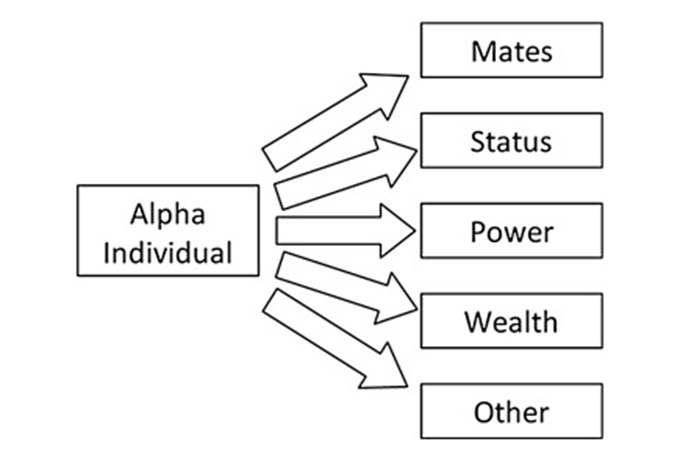
So dearly beloved reader where do you fit into the pecking order? Are you an alpha individual, a beta individual, or a gamma individual? Fortunately, it is context-specific. Within our matriarchal family, I am a beta individual. If you are working in a large organisation you need to consider the entire Greek alphabet from alpha to omega. Even if you are the richest man on the planet and the alpha male at Tesla the shareholders can peck you if you get too greedy. The alpha position is never stable, and the betas will clamour for your position and when you stumble or get too old, you will tumble.
But even a temporary tenure in the alpha position will hopefully enable you to make money and, of course, your position in the pecking order can be bought. Any number of sycophants will attend to you if there is money to be made. Luxurious accommodation, fine dining, concierge services, and any number of the finer things in life can be bought. All things described as “tasteful”, “refined”, “discerning” and many other such words are just code for being expensive things that those lower down in the pecking order can’t afford. Is that equitable, fair, and just?
Understanding the dominance hierarchies around you is the key ingredient to navigating power dynamics. Who has the power, how will it be wielded and how it will affect you is essential to understanding a lot about your life.
My brother related a very simple example from our childhood. He often accompanied my mother to the local vegetable shop where the charming, obsequious Greek owner would assist you in buying the freshest and most delicious fruits and vegetables. We had a large avocado tree in our garden which produced many more avocados than we could eat. So, my entrepreneurial brother collected a sack of avocados and went to see the vegetable shop owner. As always, he was greeted warmly. However, as soon as it became clear that he was not a customer but one potential supplier amongst many his demeanour changed instantly. He barely looked at the avocados and made a paltry offer. A valuable life lesson. How you get treated is so often about power dynamics and your position in the hierarchy.
Is it perhaps only within your inner circle of friends and family that social justice and fairness prevails? Even then in many families and friendship circles, there are hierarchies and power dynamics. Perhaps I’m being too cynical and nihilistic. I do find a lot of meaning from my friends and family and those less fortunate than me. I also do not resent those more fortunate than me. There is a lot to like about the humanity of those around me. Just don’t forget about dominance hierarchies and power dynamics.
But will the woke succeed in creating equitable systems that prioritise fairness and justice for all individuals? Not a chance.
I want to express my gratitude for all the ideas and comments received. I genuinely appreciate them, and please continue to share your thoughts.
Regards
Bruce
 Ruminant Pink Friday
The elite’s ‘luxury beliefs’ about privilege spare no thought for ordinary people like you and me
A
Rob Henderson
28 February 2024 • 6:00pm
https://www.telegraph.co.uk/books/authors/rob-henderson-book-troubled-elite-beliefs-white-privilege/
35
I grew up poor, moving between foster care homes in LA county, before I encountered the middle class in the military, and later found myself ensconced in affluence at Yale. My story would be incomplete without reflecting on these different groups.
My views have been fashioned by the hardships I’ve encountered and the lessons I’ve derived from them: foster care, extreme instability, divorces, separations, gaining parents, losing parents, gaining siblings, losing siblings, and all of the pain, numbness, thrill-seeking, violence, and substance abuse that results.
Throughout these experiences, I learnt a lot about those who sit at or near the apex of that ladder, which led me to develop the concept of “luxury beliefs” – ideas and opinions that confer status on the upper class at little cost, while often inflicting costs on the lower classes.
When I was in foster care, doctors, psychologists, social workers, and teachers would often use the word “troubled” to describe me and the other kids who were overlooked, abandoned, abused, or neglected. For as long as I could remember, I felt a constant undercurrent of throbbing rage, along with anxiety and shame for being abandoned – for being unwanted.
I went to Yale to major in psychology, but my generative curiosity soon overflowed the boundaries of my degree. In my attempt to understand class distinctions, I spent a lot of time thinking and reading about class divides and social hierarchies and compared what I’d learnt with my experiences on campus.
Gradually, I would learn the tastes and values of the group that I had not fully joined. I managed to piece together the luxury beliefs concept from my observations and readings to understand what I was seeing.
In the past, people displayed their membership in the upper class with their material accoutrements. But today, luxury goods are more accessible than before. This is a problem for the affluent, who still want to broadcast their high social position. But they have come up with a clever solution: the affluent have decoupled social status from goods and reattached it to beliefs.
Denizens of prestigious institutions are even more interested than others in prestige and wealth. For many of them, that drive is how they reached their lofty positions in the first place. Fueling this desire, they’re surrounded by people just like them – their peers and competitors are also intelligent status-seekers. They persistently look for new ways to move upward and avoid moving downward.
It’s impossible to say that every individual in a particular class or category has the exact same features across the board. Still, graduates of elite universities generally occupy the top quintile of income, often wield outsized social influence, and are disproportionately likely to hold luxury beliefs that undermine social mobility.
For example, a former classmate at Yale told me “monogamy is kind of outdated” and not good for society. I asked her what her background was and if she planned to marry. She said she came from an affluent family, was raised by both of her parents, and that, yes, she personally intended to have a monogamous marriage – but quickly added that marriage shouldn’t have to be for everyone. She was raised in a stable two-parent family, just like the vast majority of our classmates. And she planned on getting married herself. But she insisted that traditional families are old-fashioned and that society should “evolve” beyond them.
My classmate’s promotion of one ideal (“monogamy is outdated”) while living by another (“I plan to get married”) was echoed by other students in different ways. Some would, for instance, tell me about the admiration they had for the military, or how trade schools were just as respectable as college, or how college was not necessary to be successful. But when I asked them whether they would encourage their own children to enlist or become a plumber or an electrician rather than apply to college, they would demur or change the subject.
‘My classmates promoted one ideal while living by another’: A protester holds a ‘Defund The Police’ placard outside Downing Street, 2021
‘My classmates promoted one ideal while living by another’: A protester holds a ‘Defund The Police’ placard outside Downing Street, 2021 CREDIT: SOPA Images
Top universities are also crucial for induction into the luxury belief class. Take vocabulary. Your typical working-class American could not tell you what heteronormative or cisgender means. But if you visit an elite college, you’ll find plenty of affluent people who will eagerly explain them to you. When someone uses the phrase “cultural appropriation”, what they are really saying is, “I was educated at a top college.”
Only the affluent can afford to learn strange vocabulary, because ordinary people have real problems to worry about. The chief purpose of luxury beliefs is to indicate the believer’s social class and education. When an affluent person expresses support for defunding the police, drug legalisation, open borders, looting, or permissive sexual norms, or uses terms like “white privilege”, they are engaging in a status display. They are trying to tell you, “I am a member of the upper class.”
White privilege is the luxury belief that took me the longest to understand, because I grew up around a lot of poor white people. Affluent white college graduates seem to be the most enthusiastic about the idea of white privilege, yet they are the least likely to incur any costs for promoting that belief. Rather, they raise their social standing by talking about their privilege. In other words, upper-class white people gain status by talking about their high status.
Henderson: ‘When an affluent person expresses support for drug legalisation…they are engaging in a status display’
When policies are implemented to combat white privilege, it won’t be Yale graduates who are harmed. Poor white people will bear the brunt. The upper class promotes abolishing the police or decriminalising drugs or white privilege because it advances their social standing, not least because they know that the adoption of those policies will cost them less than others.
The logic is akin to conspicuous consumption: if you’re a student who has a large subsidy from your parents and I do not, you can afford to waste $900 and I can’t, so wearing a Canada Goose jacket is a good way of advertising your superior wealth and status. Proposing policies that will cost you as a member of the upper class less than they would cost me serves the same function. Advocating for sexual promiscuity, drug experimentation, or abolishing the police are good ways of advertising your membership of the elite because, thanks to your wealth and social connections, they will cost you less than me.
Today, I am immensely grateful for how my life has turned out. Really, it feels like I’ve woken up from a nightmare. People have told me that my story has brought them to tears. That’s never been my intention – I don’t want pity. I’m one of the lucky ones. There are many kids who have suffered far more. Some of them never recover from what they’ve endured. I’ve lost touch with most of my high school friends, but here is the last of what I know of how their lives turned out.
My friend Cristian has been released from prison and, as of three years ago, was unemployed. Tyler cleans carpets for a living. Two years ago, he posted an Instagram photo of himself with a facial disfigurement because he had wrecked his motorcycle again. I recently told him he’s not a criminal anymore, he’s a “justice-involved person” (a replacement term suggested by the luxury belief class). He replied, “Yeah, OK, and you’re not a college grad anymore. You’re a ‘classroom-involved person’.” It’s possible that my friends were never going to go to college. But if they’d had different upbringings, they wouldn’t have wound up in prison.
LikeLike
Interesting article
LikeLike
Happy to co-ruminate when you are planning your BDSM blog . . . ð
Terri Carmichael
Associate Professor | Wits Business School [cid:image-2299-2562659@localhost]
E: Terri.Carmichael@wits.ac.za T: +27 11 717 3657 +27%2011%20717%203657 M: +27 82 458 9583 W: http://www.wbs.ac.zahttps://www.wbs.ac.za/
[cid:image-162198-2562659@localhost] [cid:image-1467-2562659@localhost] [cid:image-1471-2562659@localhost]
2 St Davids Place, Parktown,
Johannesburg
[cid:image-3659-2562659@localhost]
LikeLike
Thanks Terri. Your skillset is larger than I thought.
LikeLike