
Aweh dearly beloved fellow ruminants & groupies
This week, as promised and since the holidays are over, I will return to the topic of energy. Looking at some of my earlier blog posts on energy there was a lot of engineering techno-nerd stuff written by someone in the mirror who has extreme intuition about all things chemical, electrical, and mechanical and utter social ineptitude. Although there is a portion of my readership that are like-minded social misfits there is a growing proportion that are better looking socially sophisticated non-technical really clever people much higher in the dominance hierarchy who make all the decisions. They generally don’t pay too much attention to the opinion of people who need to use the tradesmen’s (is that a gender microaggression?) entrance rather than the executive entrance.
Notwithstanding this, I will try to write a more accessible blog post on some of the more farcical things playing out in the energy transition. For my fellow tradesmen and social misfits, I will provide some links to some uber techno-nerds who do the proper deeper analysis that is not relevant for the decision-makers.
In recent years, the astute minds in the European Union and the United States have grown impatient with the sluggish pace of the energy transition. Consequently, they have reintroduced the concept of industrial policy along with a substantial pot of subsidy money. In South Africa, industrial policy is also in vogue, though the state’s insolvency and the imperative to finance corruption tend to overshadow energy subsidies, except where corruption might be facilitated. In the United States, the oddly named Inflation Reduction Act (IRA) allocates a subsidy pot for the energy transition, estimated to reach as high as$515 billion over the next decade. This has raised concerns in the EU, leading to proposals allowing European governments to match the subsidies offered in the United States—a sort of subsidy pissing contest if you will. One may speculate what President Chump will do about all of this.
Unsurprisingly there is now a flurry of organisations seeking to harvest the subsidies. Because the future technological landscape is uncertain the thinking is that you should liberally sprinkle the subsidies across many options and see what flowers bloom in the end. Although a technology might be very expensive and impractical now as it scales and improves it will become much cheaper and competitive later. There is a small bunch of heretical tradesmen who take into consideration arcane things like physics, thermodynamics, and economic comparisons with alternative technologies. They do this using basic science and economics calculations any competent engineering undergraduate can perform.
Imagine, if you will, a drag race competition where the goal is to traverse a straight track from point A to B as swiftly as possible. On the left, there’s a net-zero battery electric Ferrari (red of course), and on the right, a donkey cart. Supporters of the donkey cart concede its current inability to compete but present compelling PowerPoint slides outlining genetic engineering, donkey breeding, advanced nutrition, and graphs showcasing remarkable improvements in donkey performance. Providing a generous subsidy for a donkey improvement program and adopting a positive mindset might lead to unforeseen possibilities. Donkeys are also touted as more environmentally friendly than battery-electric Ferraris, and they can be bred by the less affluent. For those less enamoured with donkeys, there are alternative projects involving tortoises, hares, huskies, and even unicorns, as the winner of the race remains uncertain. After all, the tortoise once defeated the hare—though some may justly accuse me of exaggerating for effect, and so perhaps in certain cases it’s more akin to a Toyota Corolla versus a BMW, with the BMW still emerging victorious.
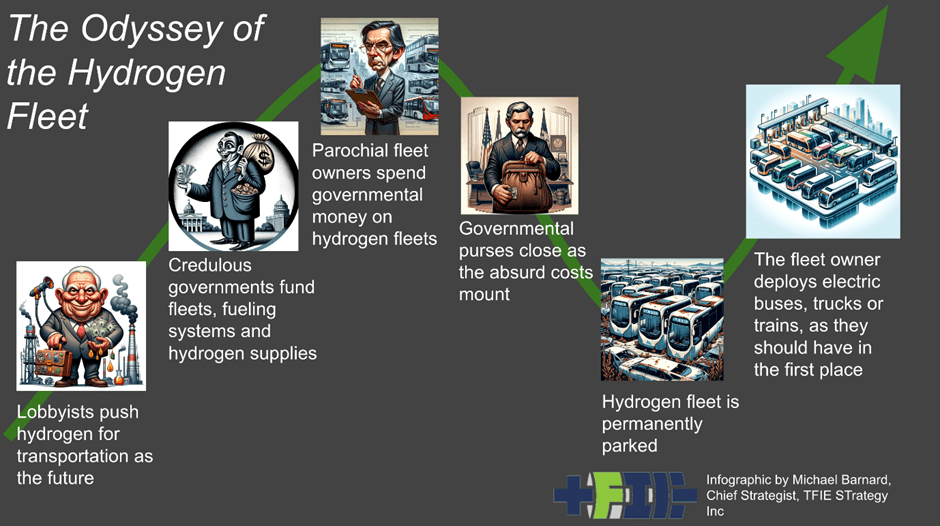
Many tradesmen eagerly join the subsidy feeding frenzy, embodying Upton Sinclair’s quote, “It is difficult to get a man (microaggression) to understand something when his salary depends on not understanding it.” There is, however, a small group of heretical tradesmen tirelessly debunking the donkey carts. One of them is Michael Barnard who writes many detailed technical and economic articles in Clean Technica and Forbes magazine and I have chosen one of them relating to fuel cell electric forklifts, trains and buses using green hydrogen and how they compare to the battery electric alternative. He suggests that every initiative follows a similar path with grifters, hucksters and dupes involved. The grifters and hucksters are just in it to make money and the dupes are the useful idiots who drink the Kool-Aid. The easiest source of money is government subsidies, but dumb shareholder money is also sometimes involved. Just as a Ponzi scheme follows an inevitable series of steps the hydrogen bus projects follow a predictable series of tragic steps until the reality sinks in that the hydrogen buses are impractical and too costly and expensive to run, and they are scrapped. He documents several failed schemes and yet they persist. Despite several failed schemes, the concept of subsidy harvesting persists as the underlying business model.
For the techno nerds and those that have the interest and nothing better to do, there are fellow hydrogen skeptics at the hydrogen science coalition as well as Michael Liebreich. They do the required thoughtful technical and economic analysis to counter the hype. Even BCG, management consultant royalty, has started to temper the hype around hydrogen in their latest report. But as with any good management consultant, although they now recognise that hydrogen is very expensive, they wish to keep their bread buttered on both sides. They recommend more regulatory support, in other words, more subsidies. There is not enough punch in the punch bowl at the party so please bring another big bowl so the party can continue.
It is not that there are no other renewable energy alternatives. Direct use of renewable electricity provides a better alternative than hydrogen for most applications such as residential and commercial heating and cooling.
Does any of this matter? Is this not the nature of how progress is made? We try out various alternatives and, in this way, we learn what is best. The Ferrari must compete with the Red Bull and the Mercedes and together in this competition they become better and faster. We can even introduce Formula E to potentially replace Formula One. But Formula Donkey Cart seems a bit dubious, unless, of course, it receives substantial subsidies.
Maybe subsidy harvesting looks like a victimless crime but if the decisions are made by clever politicians, grifters, and the technically illiterate then many donkey carts will be generously subsidised through industrial policy. This is going to significantly slow down the energy transition.
At this point, as new extra large punch bowls are being prepared by the EU and the USA, I will quietly slip out the back using the tradesmen’s entrance and continue to piss into the wind.
I want to express my gratitude for all the ideas and comments received. I genuinely appreciate them, and please continue to share your thoughts.
Regards
Bruce
 Ruminant Pink Friday
Hi Bruce,I think I qualify as half tradesman and 1/4 management , now rising in retirement skills.The whole point of subsidies is that they are to be harvested by encouraging investment. It would be wrong to blame the investors/ opportunists for the failings of others, except where the investors create the subsidies through lobbying. If it’s one thing that’s wrong with capitalism – the lobbying and associated back handers are one of the downside consequences of a “free” market. I guess you could argue subsidies are not part of capitalism- but then tell me a capitalist based country where they are not applied. Your point though I think is warping science to suit the pocket – and I can’t see any easy fix to that. It’s been the sauce of innovation investment for time eternal for those selling a pitch looking for funding, and that always been, and will always be, caveat emptor. So – I hear the complaint, but you don’t offer a realistic fix. You will just need to keep shouting from the roof tops in the hope that investors smarten up. Cheers,Mark
Sent from Yahoo Mail for iPhone
LikeLike
Thanks Mark. As you say the best solution is caveat emptor and simple techno-economic analysis as well as looking at the alternatives. In addition, often history is ignored. For example fuel cell electric buses have been tried in many places and follow a the predictable route and fail. Yet new schemes pop up ignoring the lessons of history. This reflects laziness (or corruption) on the parts of the funders.
There is a growing body of evidence that electrification is the most cost effective and practical way to decarbonise for most applications and not moving hydrogen molecules around. High Voltage Direct Current (HVDC) electricity transmission and submarine (undersea) HVDC is a commercially proven way of moving electricity large distances. For example, from North Africa to Europe, or from Spain to the UK.
The fossil fuel majors are in the business of making and selling molecules. Electrification is not part of their skill set and electrification represents an existential threat to them. They are this pushing hydrogen very hard and doing subsidy harvesting. The answer here is education of the funders on the techno-economic fundamentals to become more selective in funding. I do think this is very slowly starting to happen.
Also in more technocratic societies like Germany the penny is starting to drop and a significant backlash is starting to develop against pissing away billions of Euros on non viable projects. This is one of the driving factors in a political realignment in Germany. Ultimately my best guess is that while there will be a lot of studies on GW scale green hydrogen projects and other non-viable technologies but when it comes to FID sanity might prevail.
LikeLike
My two favourites are algae as a replacement energy source for a refinery. I rather flippantly said that you would need a vat the size of Ireland to produce the same amount of energy. My friend, who is a Professor in Marine Technology said in fact it would have to be the size of France. As far as I know, the technology is still being promoted by amongst other agencies, Exxon.
Secondly, the cities in America that had to get rid of their battery buses which couldn’t even approach cost effective mileage in sub zero temperatures.
LikeLike