

Aweh dearly beloved fellow ruminants & groupies
In a moderate-risk long-term investment portfolio, it is often desirable to find solid, even dull, companies that reliably generate cash, pay dividends, and exhibit reliable growth above inflation. Think about a company like Tiger Brands which is more than a hundred years old and sells food staples with some of the best-loved food brands in South Africa. Black Cat peanut butter, All Gold Tomato Sauce (the South African equivalent of Heinz ketchup), Mrs Balls chutney, and many others. Virtually every trolley of South African groceries will contain one or more Tiger Brands products.
Even with all South Africa’s problems people need to eat. This should be a solid and reliable business that you should be able to add to a conservative portfolio for your mother. Would you have done well if you bought Tiger Brands ten years ago? Not so much. There has been a spectacular destruction of shareholder value. Look at the chart below showing the share price history for 10 years.
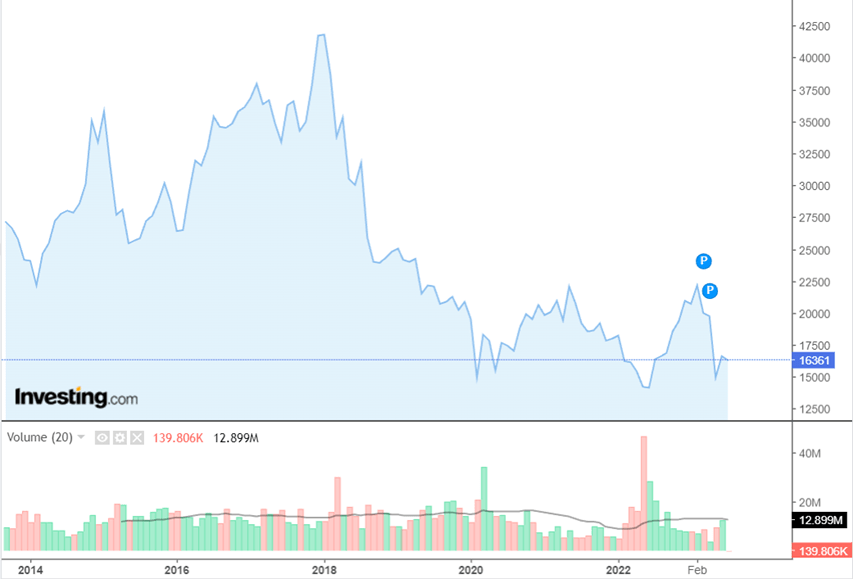
Ten years ago, the share price was R269 ($26.37) and today it is R164 ($8.77). So, if you invested $100 in Tiger Brands ten years ago it would be worth $33.27 today. Dividends have been paid in the intervening ten years, but this is meagre compensation for the spectacular destruction of shareholder value.
Tiger Brands is by no means unique and there are many examples of what should be solid businesses that have lost their way. The details of why a particular company has destroyed value may have some unique features but one needs to hold management and the board accountable. Can one start with a dysfunctional management culture? This is perhaps the golden thread that runs through all poorly performing companies.
In 2008 Tiger Brands paid a fine of R98 million to the competition commission for collusion and price fixing for bread. The chairman at the time said that there were “weaknesses” in the ethical culture of the company. In the history of understatements perhaps this deserves to be nominated for the Oscars of understatements.
Did Tiger Brands learn from this and change its culture? In a word no. This is not a well-run company. In 2018 the company was implicated in the worst global outbreak of listeriosis in one of its cold meat factories.218 people died and many have been left permanently disabled or disfigured. Did Tiger Brands take responsibility for this tragedy? Not at all. They handed the problem over to their insurance company and their lawyers who have done everything possible to deny and delay. After years of litigation, the supreme court of appeal (SCA) delivered a stinging judgement accusing Tiger Brands of going on a fishing expedition subpoenaing hundred or irrelevant documents. Five years later the legal battle is still dragging on. Tiger Brands has still not accepted responsibility or compensated the victims. How will this end? In 2008 the fact that Tiger Brands had an unethical culture was flagged and now 15 years later I leave you to judge whether the company still has an unethical culture. Changing an entrenched company culture is no easy thing. This culture has destroyed an enormous amount of value and it has killed people.
If you are a talented and ethical young graduate aspiring to build a career and climb the corporate ladder into management how attractive would you find Tiger Brands?
It is not only an unethical culture that can cause shareholder value destruction. There are many ways to destroy shareholder value. An insular and hierarchical culture where poor capital allocation decisions are made is just as effective at destroying shareholder value as being unethical. Along with many other companies, Tiger Brands went on an ill-fated offshore acquisition spree and neglected its core brands at home. It has lost market share and faced squeezed margins. The company got its fingers burnt with the offshore acquisitions which have subsequently been sold at a loss.
There are any number of cultures that can destroy value and changing an entrenched value-destroying culture is no easy matter. Every unhappy family is unhappy in its own way.
As a junior employee or middle manager, what is it like to work in an organisation that is destroying shareholder value over the long term? You have little influence over the senior management culture. Telling the emperor and his inner circle that the company culture might be unethical might not be the smartest thing to do. For those who are unable to leave disengagement is one way to deal with your concerns. Work is transactional, and you are not responsible for your organisation’s culture, but this will not necessarily be sufficient to protect you. Companies that destroy value are often subject to recurring cost-cutting exercises and cycles of retrenchments to try and survive. These cycles are profoundly damaging to the company and the corporate morale. The talented and mobile are often the first to leave. It is better to work for an organisation that is creating value.
Would it be a good idea to buy Tiger Brands now? Does it not perhaps offer good value now? It has a price-earnings ratio below 10 and a dividend yield close to 6%. Of course, dividends are not guaranteed and are the first thing to be sacrificed when things get tough. There are always those who see value in a poorly performing company. Significant value can be created if the company can be turned around. However, I would suggest that a successful turnaround would need to start with a recognition that the current culture is broken, and a radical change is required. There is little evidence of this. I would not put Tiger Brands into my mother’s portfolio. Could I be wrong? I hope for the sake of the junior employees and middle management at Tiger Brands that I am. As for executive management, it is perhaps time for the board and long-suffering shareholders to wake up and smell the (non-Tiger Brands) coffee.
Dearly beloved readers perhaps you have your own examples of companies that have destroyed long-term shareholder value.
Thank you for all the ideas and comments. I really appreciate them and please keep them coming.
Regards
Bruce

