
Aweh dearly beloved fellow ruminants & groupies
During this last week that has been more chatter about South Africa being on the potholed road to becoming a failed state. There is a Bloomberg article suggesting the failed state destination is near. The author, Richard Cookson, is a former chief investment officer at Citi Private Bank and former head of asset allocation at HSBC. Not a lightweight. This story has been picked up by Justice Malala in the local press who suggests Cookson will soon be called a racist dog. The problem is that there are now many influential people who are starting to use the term failed state in relation to South Africa. I will leave it to you to Google failed state and South Africa to see how the label failing state is starting to be associated with South Africa.
There is no officially recognised global body that awards failed state statuettes but that does not matter because if enough influential people start believing South Africa is a failing state, then South Africa becomes more and more un-investable and the failing state prophesies are self-fulfilling. I would suggest that the distinction between a failing state and a failed state is perhaps a semantic one. If you are failing, you can always fail some more.
Exhibit A in the developing narrative about South Africa as a failing state is, of course, Eskom the over-indebted state-owned electricity supplier. As I was writing this sentence the lights flickered very briefly as our inverter kicked in for our third two-hour stint of load shedding today. This week Eskom released its latest forecast for load shedding (rolling power blackouts) for the next 52 weeks. I have copied that below. How much is this forecast worth? Not a lot. The referenced article shows Eskom has consistently underestimated how much load shedding will occur. They don’t know and it’s worse than they think. To be fair it is probably accurate in predicting there will be load shedding every day for the next year.
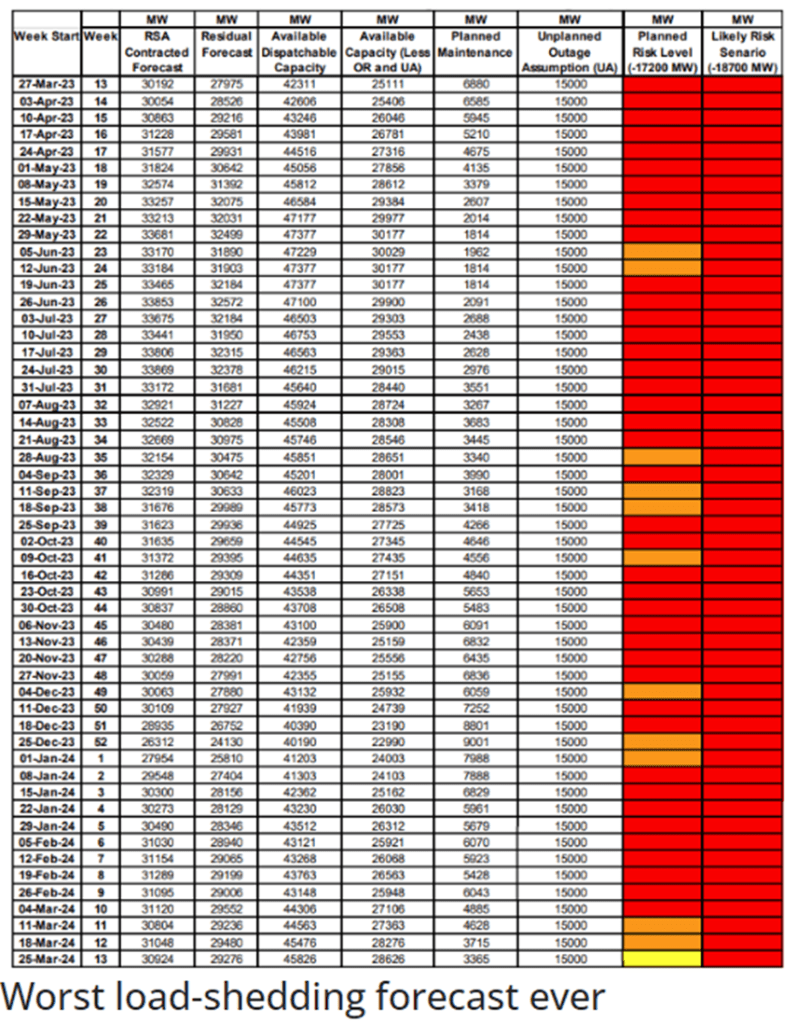
- Green: Adequate supply to meet demand. (This colour is no longer required)
- Yellow: Electricity shortfall of less than 1,000MW, meaning load-shedding may need to be implemented.
- Orange: Electricity shortfall of between more than 1,000MW and less than 2,000MW, which means level 1 load-shedding will need to be implemented.
- Red: Electricity shortfall of greater than 2,000MW meaning at least stage 2 load-shedding must be implemented.
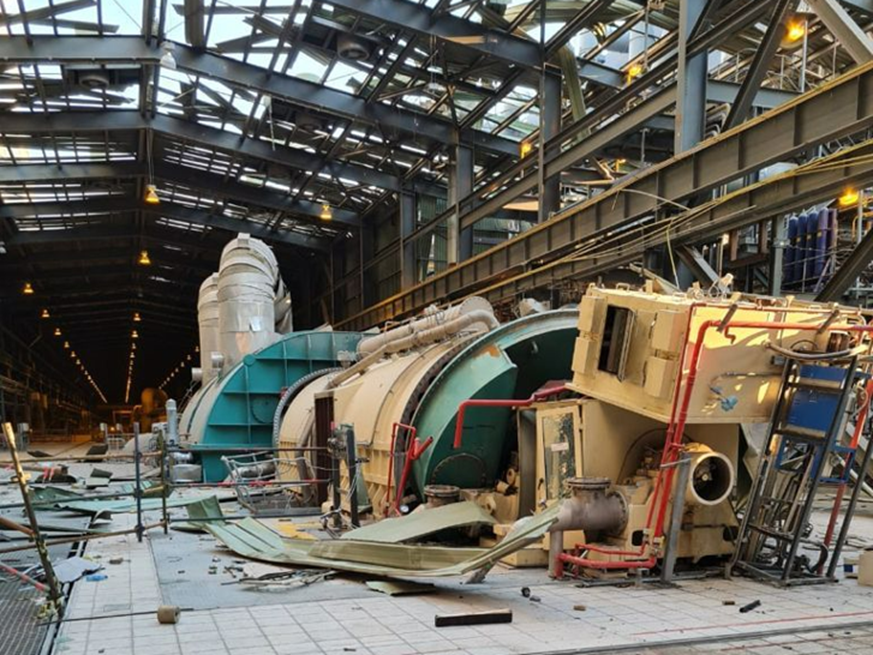
The featured image is of a brand-new GE 800-megawatt turbine that was severely damaged during commissioning in a hydrogen explosion in August 2021. Nine employees were suspended for procedural noncompliance and management failures. The damage is estimated at R2.5 billion ($139 million). The unit is still not operating and there is no indication regarding when or if it will be returned to service. This is just one small example in the public domain of what is happening at Eskom. It is the tip of the iceberg. Luckily the president has appointed a new minister of electricity who is a purveyor of good news about the problem which will be solved within two years. Even the gullible and the stupid don’t believe him.
What are resilient South Africans doing? What they always do. There is an Afrikaans expression, “’n boer maak ‘n plan” loosely translated as a farmer makes a plan. Individuals, communities, and organisations are installing solar PV on an industrial scale. Is Eskom happy with this? Not always, Eskom is taking a municipality to court regarding its plans to reduce load shedding with its own generation and allow agricultural food processing to continue in a farming community in the Free State. Long before load shedding ends (if it ever does) there will be many gigawatts of solar PV installed in South Africa. South Africa is going to be a pioneer in rapid decarbonisation by default. Eskom will be unable to stop this. Loyal paying customers are defecting accelerating Eskom’s death spiral. Of course, all of this comes at a great cost to the economy and has all but wiped-out economic growth, and if you are poor and can’t afford a solar installation sorry for you.
Exhibit B in the failing state narrative is the emerging water supply crisis. This is evolving in Johannesburg but in areas like the Kwazulu Natal South Coast water supply has effectively collapsed completely. The situation has been deteriorating for a decade with no end in sight. Since December our house in Southbroom has had municipal water perhaps two days a week. Our options are to buy expensive water from tankers or to install another tank and a rainwater collection system. This is an area heavily dependent on tourism which faces a bleak future if there is no water.
Exhibit C is crime. This was brought home to me by the recent murder of veteran journalist Jeremy Gordin in a robbery in the Johannesburg suburb of Parkview which is adjacent to Saxonwold where we live. Ferial Haffajee has written a heart-wrenching tribute to Jeremy which says it all. In it she says, “Gordin’s most quoted column is titled with a Bob Dylan lyric, “It’s getting dark, too dark to see”, in which he wrote to his children, Jake and Nina, suggesting they consider leaving South Africa. It’s an option many parents, who can, are proposing to their children, and in my experience, it’s a crisscross of race and even class as working parents put their next generations on planes out”. Among my own circle of friends, many of their children leave after completing school to study abroad and are unlikely to return. We are giving our two boys the same advice. Many of the most talented younger generation have left and many more will leave.
Given the space constraints in a weekly blog, I will stop at Exhibit C but in principle, I could continue and the 26 letters in the alphabet would not be sufficient for all the compelling exhibits that exist. Perhaps I will tackle some of them in future blogs and Exhibit D is the state of education in South Africa. Over the last year, I have had significant personal experience with schooling for the underprivileged and of postgraduate students. Our government and many postgraduate students are welded to the statist concept of the developmental state exemplified by China. Let me just say that the Chinese and South African education systems are incomparable.
Is there hope? There is always hope. I confess that now I often struggle to be hopeful but dear readers I also look to you to provide much-needed inspiration and point out the errors in my views.
Thank you for all the ideas and comments. I really appreciate them and please keep them coming.
Regards
Bruce
 Ruminant Pink Friday
Simultaneous messages from my domestic worker’s daughter and my brother informing me or their connection as her team began auditing his part of the listed company – we have come so far – there is always hope!
LikeLike