
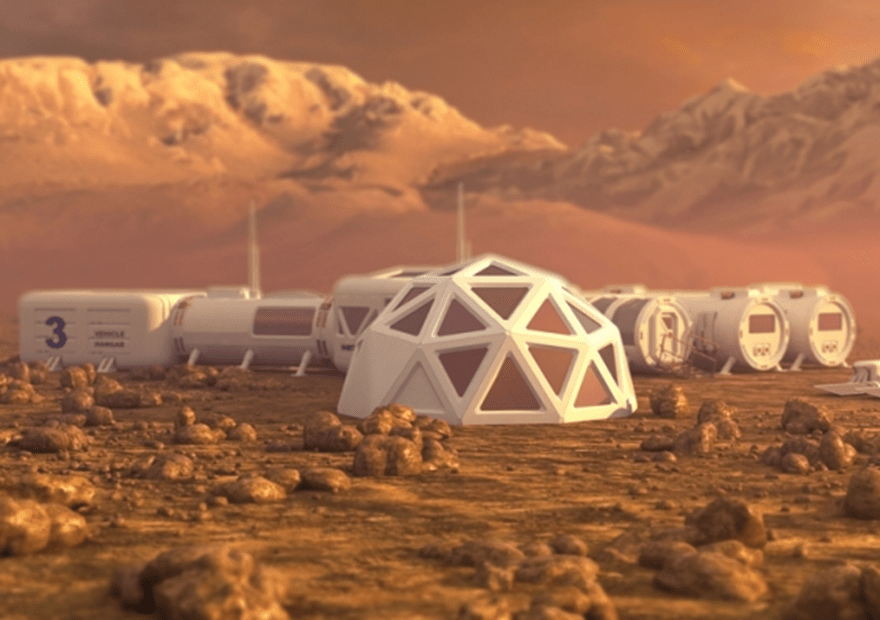
Artistic rendering of a potential colony on Mars
Aweh dearly beloved fellow ruminants & groupies
This week some eclectic philosophical ramblings from an ageing privileged white cisgender male with a colonial background. I would suggest that the three questions posed in the heading are the three most fundamental strategic questions any country, organisation or company should address. If you replace, we with I then they then become the three most important questions to think about your own life.
So lets start with the idea of colonising Mars (once a colonialist always a colonialist) and start with the question of can we do this. I chose this example because it would be extremely difficult, technically challenging and enormously expensive to do this. There is also the small matter of Mars being an extremely hostile environment for humans with an unsuitable atmosphere, water scarcity, low gravity, frigid temperatures, and no shielding from deadly cosmic rays to mention just a few. But challenges are there to be solved. So let me assume that with sufficient will, effort and money the technical challenges can be surmounted and the answer to the first question is that we can but with the caveat that it will come at an enormous cost.
The next difficult question is whether we should do this. The first part of answering this question is properly understanding the cost and the trade-offs that will be involved in starting the colonisation of Mars. The enormous bill will need to be paid and that money could have been used for a long list of mundane things like the energy transition, better education, healthcare, and many other potentially more worthy causes. But should the mundane always crowd out the exotic? Are there perhaps long term benefits that will accrue from colonising Mars that may not be fully apparent now? Are we perhaps not at our most innovative and creative when facing formidable challenges?
The second part of answering the question of should we do it is understanding the risks. The costs are very likely to escalate and perhaps enormously. The risks of expensive failures, malfunctions and fatalities are extremely high. Whose money will be used for this? Elon Musk has said he would like to die on Mars. Although I think this is interesting and clever publicity for Elon Musk the price tag for colonising Mars will likely far exceed his vast fortune. He will need help. It is difficult for me to conceive of any other ultimate source of money than the US tax payer. Could China, do it? Perhaps.
Will we, do it? Will the US taxpayer be persuaded to fund this in a democracy? Would it make America great again? I don’t profess to have the wisdom to know whether we will do it but I would suggest its not going to happen soon. It’s been almost 50 years since we were last on the Moon and Mars is a thousand times more difficult than the Moon. Many incorrect and over ambitious forecasts have been made regarding when we will set foot upon Mars. I expect many more.
So, what is the point of this Martian digression? It is that we often become very fixated on the first question of what we potentially can do. The more ambitious and challenging the better. Scientists and engineers are very guilty of this. If its pioneering, very expensive, risky and has a generous budget then that sounds like a very fun project to test your skills and show your mettle. A well-funded Martian mission will not struggle to attract some of the best scientists and engineers on the planet.
Somewhat predictably this now brings me to my pet topic the Just Energy Transition. There are many technologically challenging, risky and expensive things that we potentially can do. These include carbon capture and storage (CCS), synthetic direct air capture (SDAC) and the green hydrogen economy amongst others. They are all scientifically possible, but they are technically challenging, expensive and risky. They are also not the only options. As one does, I reference myself on this topic.
When engineers and scientists start working on these projects, they can end up spending months and years of their lives on a very interesting and pioneering project. They become heavily invested in the project and then they lose their objectivity. They become fixated on the question of can we do it not should we do it, is there a better way to do it, or will we do it. In a commercial enterprise pressure starts building up regarding when this will be commercialised and how it will make money soon. Then the forecasts and assumptions start. When these prove to be over ambitious the project team create new assumptions and forecasts on beautifully prepared PowerPoint slides sometimes with the help of management consultants. This cycle can continue indefinitely or until the money runs out or investors lose patience.
But wait a minute I hear my critics saying. All innovation must start somewhere and with the first question. This is, of course, completely correct but we should not lose sight of the second and third questions. Once the internal project team starts losing its objectivity and missing forecasts impartial critics are required to assist the team to scrutinise the second and third questions. This is often an uncomfortable and unpleasant process which the project team seeks to avoid. Rather produce new forecasts.
I would suggest that it is the innovators who embrace their critics who will be the most successful and will stop flogging the dead horse soon after its demise, or even better when it becomes evident that death is imminent, to start focussing on something more promising. Failure is an essential part of the innovation process and recognising when to throw in the towel is vital to avoid unwarranted value destruction.
Unfortunately, there are some very unhealthy-looking horses being vigorously flogged out there. Perhaps they will recover and win the race. I, however, will not be betting on those horses.
Thank you for all the ideas and comments. I really appreciate them and please keep them coming.
Regards
Bruce


We have a project in this category that has an economic case called “Stars Align Case”. Unsurprisingly this case is the only one that would give the project any hope of continuing. Methinks that subtly and with the cunning use of well-crafted slides, this case will morph into base case and the project will proceed. The details of how we’ll actually become first quartile on a range of aspects seemingly outside our control will be for the next phase to solve…
LikeLike