
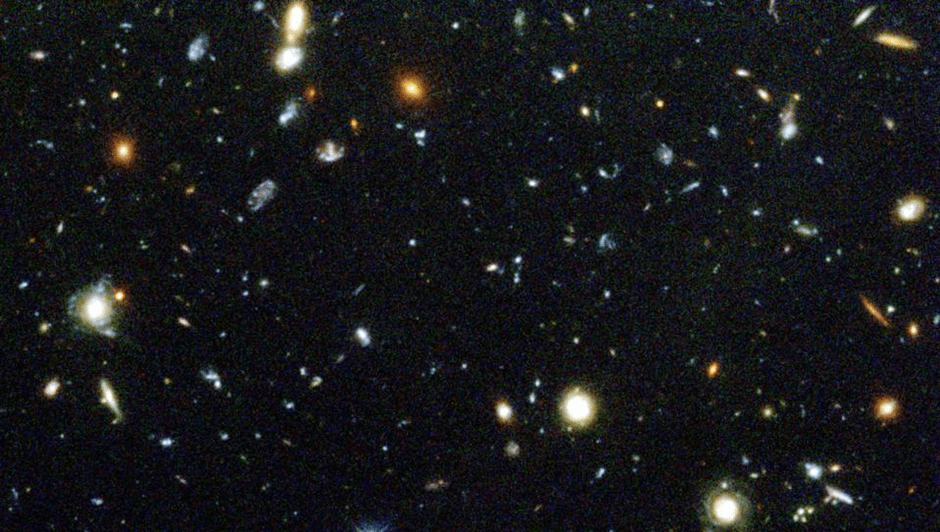
A small portion of the original Hubble Deep Field, showcasing hundreds of previously unseen galaxies. Every separate point of light in the image is its own galaxy, with billions of stars occupying each one, and with them coming in a variety of shapes, ages, and each with a different star-formation history
Aweh dearly beloved fellow ruminants & groupies
197/364 days of load shedding in 2022 – currently stage 3
So, at the end of a difficult year, it is perhaps worth reflecting on what our greatest achievement as a species is. The last two centuries have been very good to us. In 1822 the global human population was just over a billion and now there are over eight billion of us. We have been fruitful, and we have multiplied. In 1822 about 86% of the population lived in extreme poverty and today it is less than 10% and declining. The average life expectancy in 1820 was 29 years and now it is approaching 80. These are amazing achievements. Will these trends continue? Pessimists and cynics like me have warned that this party cannot continue and so far, we have mainly been wrong. In 1798 Thomas Malthus warned that food production would not be able to keep up with exponential population growth. He did not foresee the industrial and technological revolution which has allowed us to produce food on an industrial scale. The technological progress over the last two centuries has been staggering. Technical progress in my lifetime has also been extraordinary. Today I can communicate with virtually any person on the planet instantly at virtually no cost. People all over the world read this blog within minutes or hours of my posting it. Such has been the progress of computers. When I started my career, we were still typing letters on typewriters and then putting the letter in an envelope, licking the envelope, and posting the letter to the recipient. If the recipient was overseas, it would take more than a month to get a response.
This progress over the last two centuries is certainly a candidate for being our finest achievement. If one consults the great Dr. Google regarding what our finest achievements are what do we find? Some surprisingly banal and parochial stuff appears on the list. Works of art like the Mona Lisa. I am admittedly an art philistine but a painting? Why that one? Really? Literature like the works of William Shakespeare are also on the list. I wonder what the Chinese would have to say about that. Let me go out on a limb here. If an advanced alien civilisation were to visit the earth, I suggest they would not place much value on any of this.
Will our exponential progress continue? In the case of population, we are already seeing growth tapering and the United Nations population models suggest the earth’s population will stabilise at 11 billion in 2200. We are bumping into the limits of a finite planet. Thomas Malthus was only wrong in his timing. Exponential population growth on a finite planet must come to an end at some point. The same will apply to exponential economic and consumption growth. What about technology? There is still tremendous scope for technological advancement including developments we cannot even conceive of yet. Technology development has got legs.
So, what is Ruminant Pink Fridays’ view of our finest achievement? It is the enormous progress we have made in mapping our environment and the universe. We only mapped our planet about 500 years ago and we indulged our inner narcissists and believed the earth was at the centre of the universe. Later we realised that the earth revolved around the sun. Then we realised that our sun is an unremarkable star amongst more than 100 billion stars in our galaxy the Milky Way. Then less than 100 years ago it dawned on us that the Milky Way is an unremarkable galaxy amongst billions of others. The featured image is a small piece of the Hubble deep field image which is itself an image of a small piece of the sky. Everywhere you look and, in all directions, you see more galaxies. There are more than 100 billion galaxies in the known universe. Coming from the ludicrous belief that we are at the centre of the universe to our current understanding is humanity’s finest achievement. How many people know this? If I were to run a survey about the size of the universe, I suspect very few people would know the answer or would have thought about this. Perhaps more people will know about the Mona Lisa than the basic facts about our universe. A proper understanding of our place in the universe gives us a much-needed dose of humility.
The universe provides us with a tantalising glimpse of the infinite and our very small place in it. We will only be able to continue with exponential growth over many future centuries if we can escape the limitations of our planet and our very fragile biology. Will we be able to move off the earth and live on other planets? Our biology does not help. We are adapted to live in very special conditions on earth. We need a narrow range of gravity, temperature, pressure, and air composition. The earth’s magnetic field shields us from deadly cosmic radiation. We are not suited to living in space or on any nearby planet. Mars is a very challenging environment for an independent human settlement. The distances between stars let alone galaxies are so vast that they are potentially insurmountable. Dreams of colonising distant stars and planets may remain just that for the coming centuries.
But where will technological progress take us? Here is some wild, if not original, speculation. There are those that say we live in a simulation. Can we create a simulated world? We do it already with virtual reality. It is currently not very convincing but there is exponential progress. Where could this lead? In a simulated world, we could remove the constraints of our finite planet and fragile biology. If you could lead a better-unconstrained life in a simulation, with free beer, would you consider it? This is potentially the ultimate escape from the difficulties in our current world. Perhaps that would not be a good idea if the simulating computer were housed in South Africa. What would happen when the power failed, and the battery went flat? Who would be left behind to run and maintain the simulation? Is it a good idea to use people and politicians? Perhaps robots and advanced artificial intelligence (AI) could do the job better. Let us hope they are trustworthy.
Best wishes for a better and unconstrained 2023.
Thank you for all the ideas and comments. I really appreciate them and please keep them coming.
Regards
Bruce
 Ruminant Pink Friday
A fitting way to end a remarkable year! Thank you for all the insights â I am enjoying having you as a colleague âºï¸. Wishing you a fulfilling and enjoyable 2023
Terri Carmichael
Associate Professor | Wits Business School
[cid:image-593396-26383@za04.rocketseed.com]
E : terri.carmichael@wits.ac.za T : +27 11 717 3657 +27%2011%20717%203657 M : +27 82 458 9583
W : http://www.wbs.ac.zahttp://www.wbs.ac.za
[cid:image-604797-26383@za04.rocketseed.com] [cid:image-593395-26383@za04.rocketseed.com]
2 St Davids Place, Parktown,
Johannesburg
[cid:image-593394-26383@za04.rocketseed.com]
LikeLike
Thanks Terri
LikeLike