

Aweh fellow Ruminants & Groupies in day 356 of Re-Modified Lock Down Now Level 1.
Remaining Life at Sasol: 12 days
This week I am going to rework a couple of my earlier submissions into a more generic form because it is a topic so close to my heart.
This week the topic for Ruminant Pink Friday’s ™ is the subject of elegance both from a fashion and a scientific perspective. Some fashion and some science is elegant. On the opposite extreme you get a fashion faux pas as well as the scientific fashion faux pas.
I have thought of myself as an avid follower and slave to fashionable and elegant clothes. I would have classified myself as elegant, stylish and dapper. The opposite is someone who is scruffy and commits many fashion faux pas (the plural of faux pas is faux pas). https://za.pinterest.com/designsbydagmar/fashion-faux-pas/
My fashion role and roll model is Bond, James Bond. In the image below Bond is wearing the $43 000 Brioni Vanquish II suit. https://www.luxhabitat.ae/the-journal/top-10-most-expensive-suits-in-the-world/

I have several of these in my wardrobe and in my mind the resemblance between Bond and myself is uncanny. I don’t have the silver Aston Martin DB4 but I do covet that.
Unfortunately my friends and colleagues do not share this image of me as a fashion style icon and they provided me with the image below to more accurately represent their view of my fashion sense with appropriate Ruminant Pink™.

Naturally I found this extremely hurtful but after extensive and expensive therapy I have reluctantly come to accept that I should not pursue a post Sasol career as a fashion model nor should I aspire to being the next James Bond. The truth hurts. A lot.
Perhaps I should stick to where my skills lie as a scientist at heart. One can apply the same fashion based principle to science and scientific theory and communication. Some science is simply awe inspiringly elegant and beautiful like Louis Vuitton or Brioni. For the Brioni of simple elegant scientific inspiration I choose Einstein’s special theory of relativity. This formed part of the Physics II course I did at Wits in 1981 lectured by a Polish physicist Dr Vladimir Hnizdo. Starting with the very simple postulate (confirmed by the Michelson Morley experiment) that the speed of light in a vacuum is constant in all reference frames the entire edifice of special relativity unfolds from this postulate. It requires only high school mathematics. You don’t need calculus to derive special relativity. You just need to think this through properly. It was all done and dusted in a double lecture. The results are deeply counter intuitive for most people including me. You can’t travel faster than the speed of light. The size and mass of fast moving objects relative to a stationary observer change. Time dilates for fast moving objects. Mass and energy are equivalent via the very simple and famous equation:
E = mc2
As a scientist one can only stand back in awe at the elegance of what Einstein did. He also did this on his own in his spare time while he was working as a Swiss patent clerk. This work was performed without a charter, a project plan, steering and mandating committees. There was also no board approval. All it required was deep logical thought with pencil and paper by a single individual. Time and space are not what we intuitively think they are. This is the science fashion equivalent of the $43 000 Brioni Vanquish II suit. How was this radical reordering of our understanding of space and time received at the time? Apparently not so well.
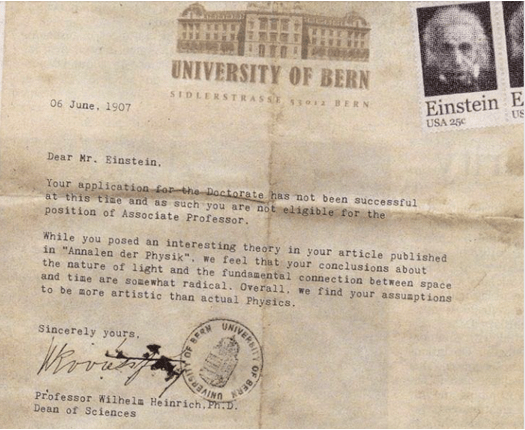
Unfortunately this letter is fake but after four years of Trump and many more of our own politicians I have learnt not to let a little bit of mendacity interfere with a good narrative. https://www.ndtv.com/offbeat/fact-checked-truth-behind-letter-rejecting-albert-einstein-shared-by-shekhar-kapur-2297368.
We now unfortunately have to go to the other side of the spectrum, the science fashion faux pas. It is depressing to see how frequently I see these. The worst examples are when accountants or economists and sometimes engineers and scientists (who have lost their way) try to make economic or financial models look scientific. The most egregious examples are when a mega project (a project > $1 billion) needs to be approved. In earlier submissions I have dealt with the motives of why employees seek to get megaprojects approved. This has little to do with creating shareholder value. https://ruminantpinkfriday.wordpress.com/2021/02/24/the-iron-law-of-megaproject-management/. The motives for getting megaprojects approved are described by the four sublimes. Engineers are led astray by the technological sublime which is described as the rapture engineers and technologists get from building large innovative and pioneering projects which push the boundaries of what’s possible. This is preferably done with other people’s money.
In order to fool the executive committee and the board an extremely complex inelegant pseudo-scientific economic model based on rosy forecasts is built. Empirically as shown in the reference on the iron law of megaprojects the rosy models usually do not predict the actual much sadder outcome.
It is hard to even know how to start to explain how scientifically ugly these models are but here goes:
- Empirical evidence shows the forecast project economic model has a low probability of being even vaguely right and unlike a good scientific theory has limited predictive power
- The model is usually extremely complex spreadsheet model with many hidden assumptions and adjustable parameters allowing the outcome to be adjusted to what you desire. Very few people understand it properly.
- Empirical evidence shows that actual project outcomes are usually worse and much worse than the economic forecasts. The project teams objective is to get the project approved not to create a realistic model.
Thank you very much for the many helpful suggestions and input which I’m researching and please keep the submission ideas flowing.
Regards
Bruce
 Ruminant Pink Friday
Within Chemistry itself there are some lovely elegant reactions which deserve appreciation. Monsanto’s methanol carbonylation process developed in the mid 1960s and successfully commercialised throughout the world using a rhodium catalyst, came out of the blue but delivered a selectivity close to perfection at incredible rates. It was always a pleasure to hear the company’s representatives talk about it.
And SASOL itself, with its ethylene tetramisation proces. The elegance of selectively joining 4 ethylene molecules together when the norm for years was to have random oligomerisation, was never really appreciated outside a select few.
You are right to highlight the downsides of scientific development, but it should not detract from the little pearls that are still out there, some still to be found.
LikeLike
Thanks Mike. Tetramerisation is indeed scientifically elegant but it has not been a commercial success. There are many reasons for that but making a commercial success of pioneering new technology is not easy. It is often the followers who make money and not the pioneers.
LikeLike
Hi Bruce. The theory of relativity also did not results in a tremendous NPV as far as I know. Let’s assume for a moment that Einstein required funding to develop it, and he had to cook a few discounted cash flow analyses along the way to coerce management to invest in it, would it have turned scientific elegance into scientific faux pas? Maybe those scientists and engineers that pursue the first-of-a-kind, technologically-mind-blowing megaprojects are a lot smarter than you give them credit for. But then again, maybe they just float along with the corporate undercurrent.
Keep blogging!
LikeLike
Hi Bruce
As far as I can tell, the theory of relativity also did not have a spectacular NPV. Let’s assume for a moment that Einstein required funding to develop it, and that he had to cook a few discounted cash flow analyses to coerce management to invest in the idea, would that have turned scientific elegance into scientific faux pas? Maybe the scientists and engineers that pursue these first-of-a-kind, supa-dupa, mind-blowing megaprojects are a lot smarter than you think. Or maybe they are just floating with the corporate undercurrent.
Keep blogging!
LikeLike
Great science is often like great art. Not necessarily appreciated or financially rewarded at the time. To the extent there is a commercial reward it often does not accrue to the scientist who makes the discovery.
LikeLike