
First circulated on 2 August 2019
Hi fellow Ruminants
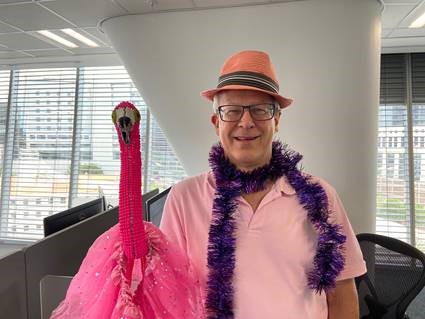
This week there has been an extremely worthy submission from an anonymous source for Ruminant Pink ™ Friday and I will park the rules theme again to explore the Gervais effect as explained by Venkatesh Rao. https://www.ribbonfarm.com/2009/10/07/the-gervais-principle-or-the-office-according-to-the-office/. https://www.goodreads.com/book/show/18581690-the-gervais-principle
Let me state at the outset that this is out there and somewhat extreme and dystopian. Is this description justified and true? Not entirely. Rao however writes very provocative click bait which he calls “insight porn”. I think this is a fair description. Most conventional management literature is about striving relentlessly towards an ideal by executing organization theories completely. This alternative school of thought starts with Hugh Macleod’s company hierarchy:

Rao suggests that you do the bare minimum organizing to prevent chaos, and then stop. Let a natural, if declawed, individualist Darwinism operate beyond that point. The result is the MacLeod hierarchy. It may be horrible, but like democracy, it is the best you can do. The Sociopath (capitalized) layer comprises the Darwinian/Protestant Ethic will-to-power types who drive an organization to function despite itself.
The Losers are not social losers (as in the opposite of “cool”), but people who have struck bargains economically – giving up capitalist striving for steady paychecks.
The Sociopaths defeated the middle management Organization Men and turned them into The Clueless not by reforming the organization, but by creating a meta-culture of Darwinism in the economy: one based on job-hopping, mergers, acquisitions, layoffs, cataclysmic reorganizations, outsourcing, unforgiving start-up ecosystems, and brutal corporate raiding. In this terrifying meta-world of the Titans, the Organization Man became the Clueless Man. Today, any time an organization grows too brittle, bureaucratic and disconnected from reality, it is simply killed, torn apart and cannibalized, rather than reformed. The result is the modern creative-destructive life cycle of the firm, which Rao calls the MacLeod Life Cycle.

A Sociopath with an idea recruits just enough Losers to kick off the cycle. As it grows it requires a Clueless layer to turn it into a controlled reaction rather than a runaway explosion. Eventually, as value hits diminishing returns, both the Sociopaths and Losers make their exits, and the Clueless start to dominate. Finally, the hollow brittle shell collapses on itself and anything of value is recycled by the sociopaths according to meta-firm logic.
The Losers like to feel good about their lives. They are the happiness seekers, rather than will-to-power players, and enter and exit reactively, in response to the meta-Darwinian trends in the economy. But they have no more loyalty to the firm than the Sociopaths. They do have a loyalty to individual people, and a commitment to finding fulfillment through work when they can, and coasting when they cannot.
The Clueless are the ones who lack the competence to circulate freely through the economy (unlike Sociopaths and Losers), and build up a perverse sense of loyalty to the firm, even when events make it abundantly clear that the firm is not loyal to them. To sustain themselves, they must be capable of fashioning elaborate delusions based on idealized notions of the firm — the perfectly pathological entities we mentioned. Unless squeezed out by forces they cannot resist, they hang on as long as possible, long after both Sociopaths and Losers have left
Please keep the submission ideas flowing!
Regards
Bruce


Hi Bruce, I certainly can attest to seeing that in practice. Suggest you explore “ergocentricity” – it’s unrelated to the above, but worthy of understanding if you are keen on relating observations to your own decision making. Cheers,Mark
Sent from Yahoo Mail for iPhone
LikeLike