
Aweh, My Dearly Beloved Fellow Ruminants & Groupies,
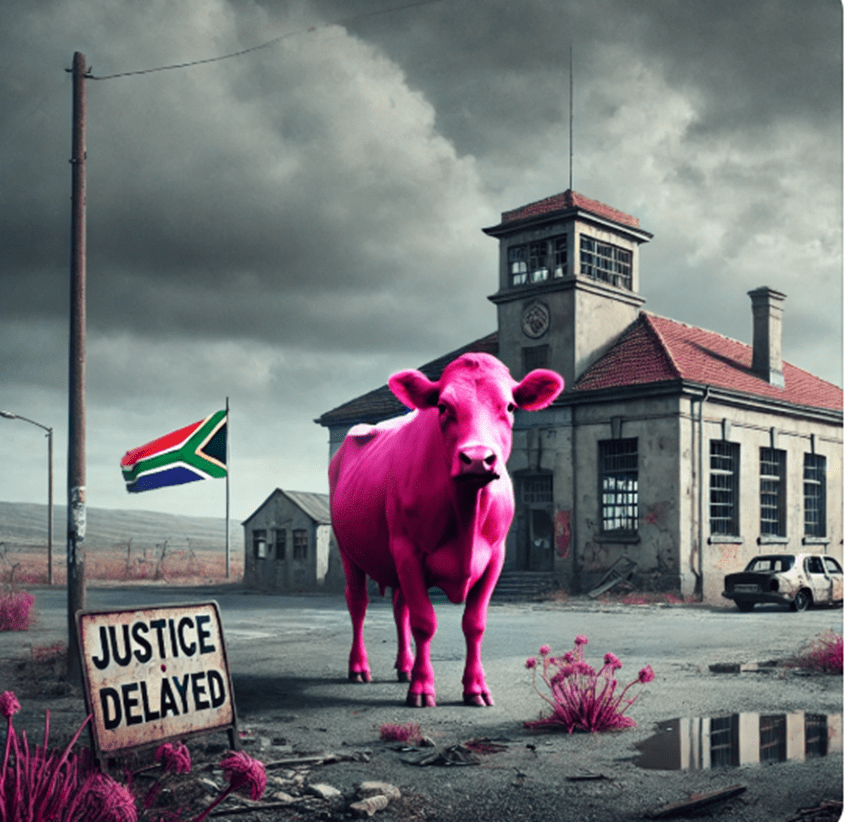
Not every Friday is soft and pastel. Some demand a darker palette. This is one of those. Perhaps next week I’ll write a breezy, hopeful rumination about looking on the bright side of 2026, fresh starts, better habits, and reasons to be optimistic. But this week, as I think about policing, justice, and crime in the country I live in, I find myself circling a darker, more persistent theme: crime, the inertia, indifference, lack of consequences, and at times, outright interference that seem to grip our institutions whenever power is implicated. Not always. But often enough to matter. Often enough to notice.
Some time ago, I wrote about our home invasion in 2003, the night a gun was pressed against my forehead, our children were in the house, and Nerine and I learned how quickly certainty evaporates…
What I didn’t fully understand then, and only see clearly now, is that my response was shaped by something deeper than fear or anger. It was shaped by obsession. And obsession, for all its danger, gets results. It’s uncomfortable, it disturbs the polite rhythms of institutions, polite dinner party conversation, and it extracts a personal toll on your health, your relationships, and your sanity. People recoil from it. But without the obsessed, do difficult things ever really get done?
And when institutions hesitate, something else moves in to fill the space.
From Victim to Volunteer
After the robbery, I joined the Rosebank Community Policing Forum, a civilian structure intended to support SAPS at the station level, improving communication, accountability, and safety. I’m still there in 2025.
That long involvement has given me a useful, if unsettling, vantage point. I’ve seen committed detectives, overworked officers, and people doing their best with limited resources. I’ve also seen how quickly matters move beyond station level and what happens next.
Once a case becomes sensitive, it is “handed over to the Province or organised crime.”
And then we wait.
For updates.
For progress.
For someone else to decide.
For Godot.
When the Violence Is No Longer Abstract
This past year has been an unusually bad one for what has historically been a relatively peaceful precinct.
The murder of Bouwer van Niekerk happened here, in our own Rosebank policing area. A lawyer working in insolvency and complex commercial matters. Lured to a meeting. Shot. Nothing stolen.
The case left the station quickly and entered an all-too-familiar fog. From the inside, there is now a wall of silence. Not hostility. Not denial. Just procedural distance, the kind that thickens when cases are deemed “sensitive.” Once it moves to the Province or the organised crime unit, communication with the station and certainly with the CPF dries up completely. No updates. No feedback. No names. Just long stretches of nothing. We are told, politely, to wait.
We wait not for justice, but for the silence to thicken into forgetting.
Earlier in the year, a woman was shot dead outside a local spa, also in our precinct. Again: nothing stolen. Again: no arrest to date.
Two targeted killings.
Two quiet files.
And a community waiting for justice.
Looking Back to Understand the Present
It matters to be precise.
Babita Deokaran was murdered in 2021.
Cloete and Thomas Murray, both liquidators, were murdered in 2023.
These are not “this year’s crimes”. They are unfinished business, and that distinction matters because it exposes something uncomfortable.
In Deokaran’s case, the gunmen were arrested and convicted. That alone proves capability. Phones were analysed. Movements tracked. Networks partially reconstructed.
What was never done, and still hasn’t been, is to follow the chain of benefit with the same urgency.
In the Murray case, the investigative challenge is harder, but not insurmountable. These were professionals operating in contested financial terrain. There are paper trails. Asset flows. Counterparties. Threat histories.
Let me be very clear here:
Finding and arresting the kingpins in the Deokaran and Murray cases is entirely doable.
This is not a mystery novel.
This is not forensic fantasy.
What stands in the way is a toxic combination of:
- Incompetence (skills gaps, overload, poor coordination),
- Lack of consequences (for failure, delay, or neglect), and
- Outright interference when investigations begin to brush against powerful interests.
Not every case suffers from all three.
But enough do.
Corruption in the police force isn’t just a case of “a few bad apples.” It’s structural, incentivised, and, in too many places, indistinguishable from power itself. The Madlanga Commission has shown us what many already knew: criminal networks don’t just infiltrate the justice system; they embed themselves in it. Promotions are traded, dockets disappear, and hitmen walk out the front door while whistleblowers get buried. Corruption isn’t an anomaly; it’s a cancer. And like cancer, it doesn’t politely stay in one organ. It spreads. Quietly. Systematically. Until you either cut it out, or it kills the host.
Fear Doesn’t Need Instructions
One does not need a written order to stop asking questions.
Fear works more quietly than that.
It emerges when people notice patterns:
- Who pushes and gets promoted?
- Who pushes and gets sidelined?
- Who pushes and ends up dead?
Fear doesn’t paralyse institutions outright. It slows them. It introduces hesitation, caution, and deferral. Files move upward. Decisions move outward. Responsibility diffuses.
At the station level, people wait.
At the provincial level, people manage risk.
And at the community level, we wait for Godot.
When Does Looking Become Reckless?
This is the question I wrestle with most.
At what point does civic engagement become self‑endangerment?
When does persistence cross into foolishness?
When does “leave it to the police” really mean “let it go”?
I ask this as someone who refused to let go, who built spreadsheets, mapped call networks, and forced momentum. I ask it now as someone older, more measured, and acutely aware that the cost of persistence has risen, that courage now attracts attention, and that obsession no longer merely exhausts, it endangers.
We are no longer dealing only with criminals.
We are dealing with criminal ecosystems that permeate every level of the system.
Institutions That Slow Under Pressure
It would be wrong and lazy to say our institutions are completely broken. Many people inside them are honest, capable, and deeply frustrated.
But it would be equally wrong to ignore the pattern:
- Some crime is pursued.
- Complex crime is delayed.
- Crime that implicates wealth, influence, or networks is approached obliquely, if at all.
Justice is not denied outright. It is deferred, diluted, and exhausted.
And eventually, fear finishes the job.
Obsession, Revisited
The magistrate once told me my obsession was unhealthy. She was probably right, but what does being healthy achieve?
But obsession doesn’t arise in a vacuum. It thrives where institutions hesitate, and consequences are overlooked. It is what happens when citizens feel they must choose between doing nothing and doing too much.
I don’t recommend obsession if you believe in all things bright and beautiful that justice emerges naturally, that difficult problems politely wait their turn, and that the universe rewards good intentions, positive vibes, and ginger shots in the morning.
To the Ruminants
Perhaps the greatest danger we face is not that justice never happens but that it happens just enough to maintain the appearance of motion.
Enough arrests to reassure.
Enough silence to protect power.
Enough delay for fear to settle in.
And so, we wait.
For Province.
For progress.
For Godot.
A society that teaches its citizens to look away should not be surprised when, one day, no one is watching.
Manifestation, mindfulness, optimism, and political correctness won’t solve this; only the obsessed will, if they live long enough.
Yours, still ruminating,
Bruce
 Ruminant Pink Friday
I love the contrast between the dark palette you mentioned and the usual bright side of new years – what inspired this shift in tone for you? 🤔
LikeLike
Hi Thanks for your comment. Perhaps its my inner nihilist versus my gratitude for being alive.
LikeLike