
Aweh, My Dearly Beloved Fellow Ruminants & Groupies,
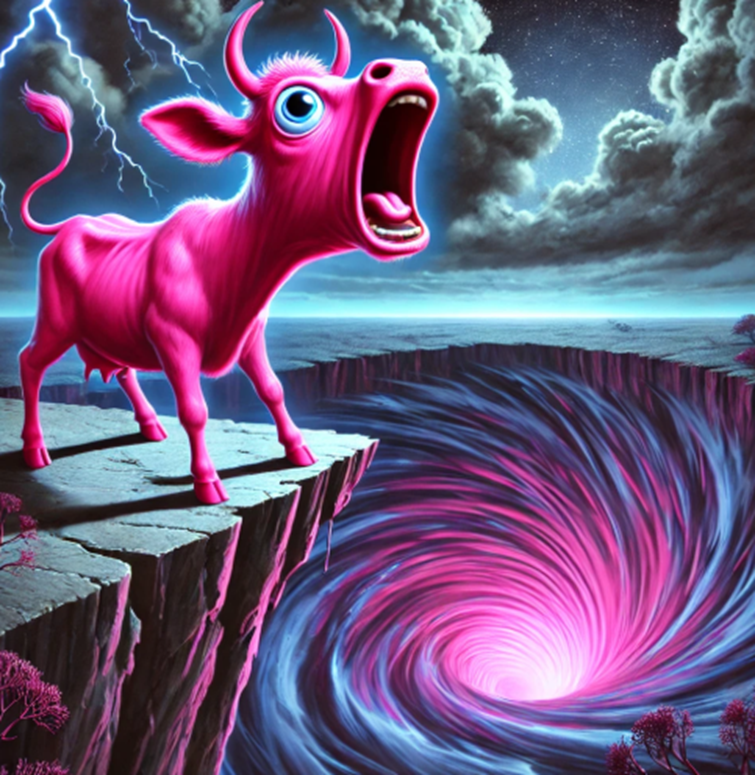
Here we are again, perched at the edge of the abyss, squinting into the darkness and wondering whether to leap, to peer, get pissed, or to simply scream. Because, dearly beloved, some of us have done something curious: we have become too conscious. The trouble isn’t that we feel, it’s that we feel everything. The good, the bad, the absurd and especially the unanswerable.
This week I’m channelling my inner Zapffe (yes, I had to dust off that obscure name) and asking: what happens when you realise you’re an animal endowed with a consciousness far beyond what nature requires?
What do you do when meaning, purpose, and comforting illusions slip through your fingers like sand?
The Over‑Conscious Animal
Here’s the painful truth: we are animals, yes.
But unlike our fellow mammals grazing under the stars, we carry a torch of awareness.
We know we will die. We know the stars will burn out. We know that matter doesn’t care about fairness, and the laws of physics don’t bother with our hopes.
And what use is a mind that can see this, yet cannot undo it?
Peter Wessel Zapffe argued that this “over-consciousness” creates the tragic condition of human existence.
We belong to nature, yet we are alien to it. We crave meaning, yet find none inherent. We reflect on our suffering and mortality, something animals don’t do, or at least not like this.
And so: the scream.
The primal scream into the void, the one you cover up with busyness, distraction, religion, ideology. But it’s still there, humming in the background.
The Abyss and the Call of the Void
The abyss isn’t just darkness.
It’s the recognition that the world doesn’t reciprocate our need for meaning.
It doesn’t care.
It offers no answers, no applause, no gentle hand to affirm that your suffering has purpose.
It just is cold, vast, and eerily silent.
And when you realise that your consciousness is staring into this mute cosmos that every prayer, every cry, every poetic metaphor might echo back only your own voice, you may feel a strange vertigo.
Not fear in the usual sense, but a dizzying intimacy with the void itself.
This is more than disillusionment. It’s the flicker of something deeper: the call of the void, l’appel du vide. that irrational whisper from the edge of the cliff that says:
“You could jump.”
Not because you want to die but because some part of you flirts with the idea of ceasing.
A flirtation with oblivion. A recognition that the edge is real, and so are you and maybe, for one horrifying instant, the two feel like they belong together.
This isn’t suicidal ideation. It’s existential vertigo: the realisation that your freedom includes the possibility of non-being, and that this freedom is terrifyingly total. You are both creature and creator, suspended between a meaningless cosmos and your insatiable hunger to make it otherwise.
The void doesn’t seduce with death; it seduces with the clarity of your insignificance.
The moment you see that nothing is holding you up, you understand that your fragile existence is a temporary blip. Against the scale of the universe, you are nothing.
Religion, Ideology & the Anchor of Illusion
Religion offers a pretty neat package:
- You are here for a reason.
- You are seen.
- You will be remembered.
- You will transcend.
For many, these truths or hopes are a balm. And truly, there’s nothing wrong with that.
If an anchor holds you steady in a storm, who could fault you for grasping it?
But for some of us, the overthinkers, the over-feelers, the restless wanderers of the interior cosmos, these anchors don’t hold.
Not because we are better or braver. Just different.
Our minds won’t stay moored.
We pull at the ropes.
We peek behind the curtain.
We question the answers.
We feel the wind of the void even when wrapped in the warmth of a thousand beliefs.
Zapffe would say religion and systems like it aren’t wrong. They’re necessary illusions.
Evolved mechanisms to preserve sanity in the face of unbearable awareness.
He wouldn’t mock faith. But he would name it for what it is: a defence against the terrible clarity of the human condition.
It helps you stand upright in the wind, yes.
But it doesn’t make the wind go away.
And for those like me, and maybe like you, the wind is all we can hear.
It howls even in the silence.
It howls especially in the silence.
Illusions for the Many, Questions for the Few
Other illusions, less holy but no less seductive, line up to soothe us:
- Nationalism says: you belong to something larger.
- Progress says: things are getting better.
- Technology says: we can fix it all.
- Consumerism says: just buy your way out of the ache.
But again, in the quietest moments when the screen is off, the party is over, and the mind returns to itself, a more primal question returns, unsummoned:
Is this true? Is this just our own vanity?
For Those Who Can’t Be Pacified
There are people for whom the world’s stories are enough, the soft assurances of religion, the elegant certainties of ideology, the comforting hum of routine. They hold these things close and are calmed by them, steadied by them. And that’s okay. Truly.
But if your mind can’t be pacified, if belief slips through your fingers like water
Know this:
You are not broken.
You are not lost.
You are not alone.
You are simply awake in a world that prefers dreams. You are simply seeing what others can’t or won’t.
And while that costs you your comfort, easy belonging, and the warm quiet of certainty
It also gives you something rare: The chance to live honestly, courageously, and without illusions.
There is a kind of beauty in that. A kind of nobility. A kind of quiet, unsentimental grace.
Or, you know… maybe it’s all just bullshit. Who’s to say?
Until next week,
Bruce
 Ruminant Pink Friday