
Aweh, My Dearly Beloved Fellow Ruminants & Groupies,
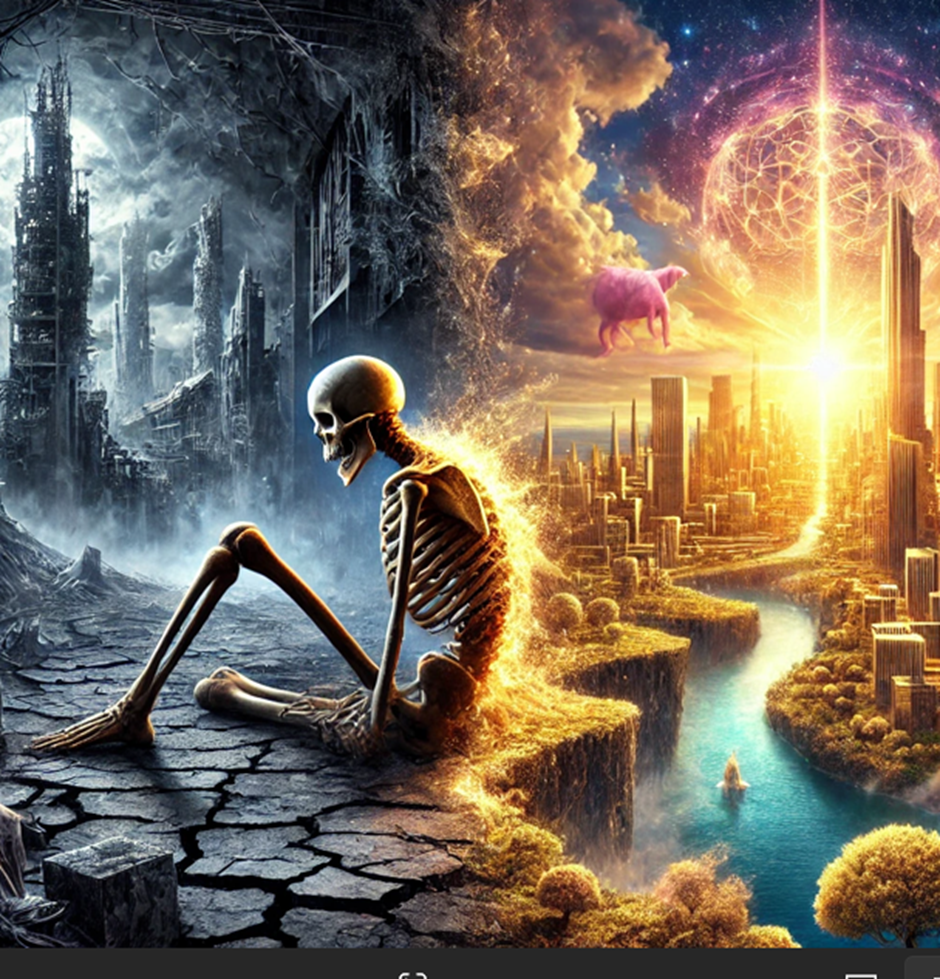
What is a Friday without some incoherent ramblings about isms? Could it be like nihilism at a birthday party—”Congrats on another meaningless trip around the sun!”
But wait, what exactly is existential nihilism? It’s the worldview that life lacks inherent meaning, purpose, or values, rejects absolute truths, and suggests that meaning is either arbitrary or a comforting illusion. Because I have self-diagnosed dissociative identity disorder (formerly known as multiple personality disorder), I often find myself identifying as an existential nihilist—particularly after a few too many glasses of wine.
And then there’s optimistic idealism—the belief that reality is fundamentally shaped by ideas, consciousness, and human perception and that things are inherently good, meaningful, and improving. To believe that I require even more wine.
So, what dragged me into this philosophical rabbit hole?
There was a greenhouse gas sentence that broke me. I was reviewing a research proposal when I stumbled upon this gem:
“The just nature of halting greenhouse gas emissions must consider social inclusivity, economic viability, and environmental sustainability to yield tangibly sound outcomes.”
Must it? Must is a mandatory requirement. You must drink water to stay alive. You must breathe. But you must consider these things? Or what? The planet will scold us?
This sentence jars with my inner nihilist and belligerent contrarian nature, which, by the way, is part of my self-diagnosed oppositional defiant disorder. So many disorders, so little time.
This reads like it was ripped straight from a climate activist manifesto. Now, don’t get me wrong—I’m all for climate activists (some of my best friends are climate activists!). But this line is so laughably out of touch with reality, it’s like declaring, “We must have world peace!”
Is it really “just” to halt emissions? If an armed policeman yells “Halt!”, it doesn’t mean “gradually slow down and stop by 2050.” It means stop. Immediately.
If we slammed the brakes on all greenhouse gas emissions overnight, the fallout would be catastrophic—especially for the poor. Sure, addressing climate change is crucial, but an instant, absolute shutdown would trigger economic Armageddon, mass unemployment, and humanitarian disasters on a scale we’re woefully unprepared for. The rich might grumble about losing their private jets, but the poor? They’d be left stranded, starving, and scrambling for survival. So no, it is not “just” to halt greenhouse gas emissions.
Now let’s talk about this thing called social inclusion.
Social inclusion means not treating people like NPCs—those background characters in video games who just follow scripts and never really participate. It’s about making sure everyone gets a seat at the table, not just the VIP section.
Think of it like a braai—instead of a select few feasting on juicy steak and gourmet wors while everyone else is stuck with dry pap and a sad spoonful of chakalaka, social inclusion means everyone gets a fair share of the fire, the feast, and the conversation—because a braai is only truly South African when everyone’s plate is full, and no one is left watching from the sidelines.
Sounds great, right? But is that how things actually work?
Not exactly.
The Life Esidimeni scandal and South Africa’s extreme inequality both expose the ugly reality behind social inclusion. While the ideal suggests that everyone gets a seat at the table, the reality is that the poorest and most vulnerable are excluded—or outright discarded.
South Africa has one of the highest Gini coefficients in the world, meaning wealth is as unevenly distributed as a plate of braai food at a corrupt politician’s fundraiser. Millions face unemployment, poverty, and lack of basic services, while the elite pile their plates high.
And then there’s Life Esidimeni—where 144 psychiatric patients died after being dumped in unlicensed, ill-equipped facilities. These were people who needed care the most, yet they were treated as an afterthought—just another budget cut. That’s not “inclusion”—that’s bureaucratic cruelty disguised as efficiency.
Until economic and political systems actually change, social inclusion will remain just a buzzword—with a few enjoying the steak while the rest scramble for scraps.
Now let’s talk about “tangibly sound outcomes.”
In South Africa, this phrase can’t just be pretty words in a government report—it actually has to work in real life. Unlike, say, the brilliant decision-making behind the Life Esidimeni tragedy.
If we’re serious about halting greenhouse gas emissions, it can’t just mean mass unemployment while politicians deliver poetic speeches under solar-powered lights. A real, measurable outcome would be corrupt officials behind bars instead of behind podiums, actual accountability instead of endless commissions, and a transition plan where the poor don’t get stuck eating pap while the elite keep dining on steak
As you might have gathered by now, I have a few problems with the greenhouse gas sentence. It’s just too easy to write nice-sounding, idealistic nonsense. It takes an existential nihilist with oppositional defiant disorder to cut through the bullshit.
At the end of the day, you can slap a “just transition” sticker on a shack fire, but it’s still a shack fire—and no amount of solar-powered virtue-signalling is gonna cook the steak evenly for everyone at this braai.
Thanks for all the comments and input.
Bruce
 Ruminant Pink Friday