
Aweh, My Dearly Beloved Fellow Ruminants & Groupies
Irreverence and satire: the twin engines of progress or the banes of hypersensitivity? Let’s dive into this contentious terrain with a little help from my role model, John Cleese.
John Cleese, a cornerstone of Monty Python’s brilliance, believes satire is a tool to challenge the status quo. In 2015, he said, “Satire makes people think.” Yet, Cleese has also warned against the rise of political correctness, which he sees as “the enemy not only of humour but of creative thinking in all areas of life.” Satire thrives on discomfort, poking at sacred cows to spark thought, not to soothe egos.
Now, what of irreverence, satire’s unruly cousin? Unlike satire, which often carries a moral or intellectual critique, irreverence simply refuses to bow. It mocks the solemn, scoffs at the conventional, and revels in tearing down self-importance—whether that’s religion, academic formality, politics, or the absurdity of taking life too seriously.
From the age of 12 when I decided to become an atheist, I have been very guilty of being satirical and irreverent. This is not a good approach if one wishes to live a quiet conventional life as a mild-mannered cog in society. Sitting around the campfire singing Kumbaya is not my style.
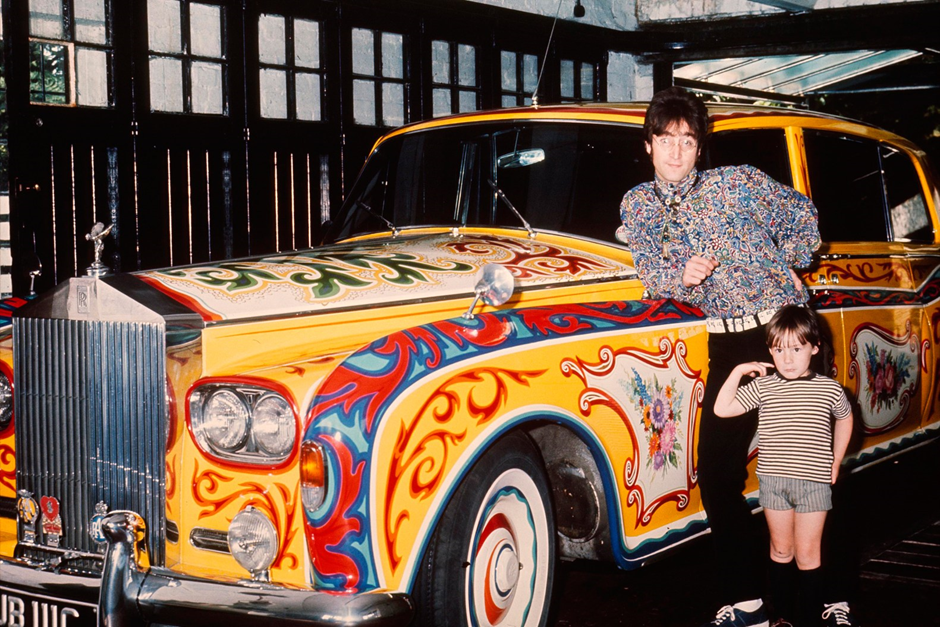
Let’s consider the featured image and John Lennon’s paisley Rolls Royce. “You swine! How dare you do that to a Rolls-Royce!” So screamed an outraged Englishwoman as John Lennon‘s Phantom V cruised past on London’s posh Piccadilly promenade in the summer of 1967. The ornately decorated limousine sprayed an electric yellow and bedecked with colourful floral tendrils, Romany scrolls, and zodiac symbols like a hallucinatory gypsy caravan, so offended her sensibilities that she briefly attacked it with an umbrella – or at least that’s the way Lennon always told the story. John Lennon is worth more than 10 million mild-mannered accountants who never offended anyone. Getting offended by a paisley Rolls Royce? Get a life!
When Oliver, my eldest son, was 18 months old we decided that it was time to get him a dog, and having grown up with Labradors I knew that they are excellent dogs for children to grow up with. And so, we got a black labrador. Nerine wanted to call him Jet, but this was too tame for me, and I prevailed, and we called him Bovril. When I was taking him for a walk as a puppy a middle-aged woman in a twinset and pearls came up to me and said, “What a beautiful dog, what is his name?” Bovril, I said. Shame on you she said he deserves a proper name like Sir Galahad.
Yet, this tiny jab at convention offended her deeply—proof that people will take offense at the smallest provocation. I have been very guilty of much bigger acts of irreverence than this and people have often taken offence.
And that’s the key: offense is often taken, not given. People often choose to be offended, projecting their own insecurities or rigid beliefs onto what’s said or done. This hypersensitivity doesn’t just limit personal growth—it suffocates critical discourse. If you can’t separate your identity from your opinions, you’re not engaging in dialogue; you’re barricading yourself in an echo chamber.
Irreverence exists to challenge the comfortable and the conventional. When offense is weaponized to silence bold ideas, we lose the nuance and depth necessary for real progress. Over-sanitised language doesn’t shield us—it stunts us. You’ve heard it before: “corporate restructuring” or “pursuing other interests.” Euphemisms are the refuge of the timid.
In 1633, Galileo Galilei stood before the Inquisition for daring to suggest that the Earth revolved around the Sun, defying the Church’s geocentric doctrine. His irreverence toward the “sacred” cosmology of the time paved the way for modern science. Though forced to recant publicly, Galileo’s work continued to challenge authority and inspired a wave of scientific progress during the Enlightenment. His defiance wasn’t just an act of rebellion—it was a critical step toward questioning dogma and embracing evidence over tradition.
However, the personal consequences for Galileo were severe. He was tried and sentenced to house arrest, forced to recant, and publicly disgraced. In 1992, over 350 years after his trial, the Catholic Church formally acknowledged its error in condemning him, rehabilitating his legacy.
The hypersensitive insistence on “safe spaces” risks turning intellectual environments into padded cells where tough questions are avoided instead of confronted. Irreverence, satire, and bold ideas are vital for innovation. So, let’s toughen up, stop taking ourselves so seriously, and raise a glass to the gloriously irreverent.
Let’s hope that in 2024 the ideals of freedom of speech and academic freedom are not drowned out by conventional wisdom, orthodoxy, political correctness, and safe spaces.
Down with safe spaces—here’s to stirring the pot.
Thanks for reading, as always.
Regards
Bruce
 Ruminant Pink Friday