
Aweh dearly beloved fellow ruminants & groupies
How much are we truly anchored in objective reality? Do you live in the real world? Objective reality refers to the existence of things, events, and phenomena independent of individual perceptions, opinions, and interpretations. It is the idea that certain aspects of the world exist objectively, regardless of whether anyone is observing or experiencing them. In other words, objective reality exists “out there” in the world, regardless of our subjective experiences or beliefs. But the lens through which you observe reality and create a picture of it is formulated in your brain.
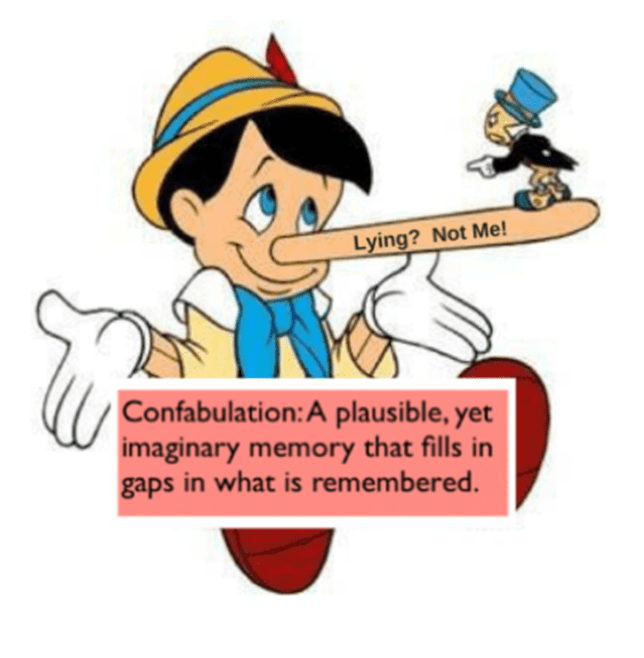
Regrettably, our brains aren’t flawless. They tend to confabulate, producing fabricated or distorted memories without any intention to deceive. People who confabulate can present incorrect memories, ranging from subtle alterations to outright bizarre fabrications. They’re often immensely confident about these recollections despite contradictory evidence.
Your brain attempts to create an explanatory narrative and to fill in unexplained gaps in your reality. This is part of how you make sense of the world and how your brain creates a coherent inner world for you based on partial and incomplete information.
Revealing and intriguing experiments have been performed on patients who have had the left and right hemispheres of their brains surgically separated. This means that the brain hemispheres cannot communicate with each other. This is a last-resort surgical option for patients with severe epilepsy. The vision in your left eye is processed in the right hemisphere and vice versa. Speech is processed in the left hemisphere.
For these patients, from the point of view of the left hemisphere, responses coming from the right hemisphere are generated non-consciously. Studies involving a patient who could read via his right hemisphere were designed to elicit behavioural responses by presenting visual verbal commands to the left visual field. The experimenter then asked out loud, “Why did you do that.” The patient then responded via his left hemisphere with a verbal answer. The left hemisphere routinely took things in its stride, telling a tale that made the responses make sense. For example, when the command to the right hemisphere was “stand up,” he (his left hemisphere) explained his action by saying, “Oh, I needed to stretch.” This was obviously pure confabulation since the left hemisphere was not privy to the information that instructed him to stand up.
To account for these findings, the theory of cognitive dissonance provides a potential explanation. The theory proposes that mismatches between what one expects and what actually happens create a state of inner discordance or dissonance. Because dissonance is stressful, it demands reduction. Thus, when the patient became aware that his body produced a response that “he” did not initiate, dissonance resulted, and the confabulation of a reason why the response occurred was a means of reducing dissonance. Today, “post-decision rationalisation” is an active research topic that examines how people retroactively justify their decisions and actions in life. An example of this is post purchase rationalisation. Once you have bought an expensive BMW it becomes a much better option than an Audi or a Mercedes Benz.
Our brain uses confabulation to fill in the missing pieces in our own reality, even if it means altering reality. When faced with overwhelming or incomprehensible information, the brain might omit details or fabricate stories to make sense of it all, even if these stories aren’t true.
In emergencies, quick decisions are necessary, but our experience might not reflect the complete truth. Different individuals may have wildly different experiences of the same event. My own near-death experience had stark differences from Nerine’s account. Trusting solely in my own experience is to succumb to my own confabulations. Neither my experience nor Nerine’s holds the absolute truth, but together, they might get closer.
How can one deal with this? Being aware that everybody confabulates and that it is not necessarily malicious is a good start. Be skeptical. Where you can check the facts and gain more information. Your reality and objective reality are not the same thing. Be aware that your version of reality is flawed.
As men age, forgetting to zip up becomes a common occurrence. I claim to rarely forget, but Nerine tells a different tale, frequently reminding me otherwise. Is it a big deal? Maybe not now, but it’s an initial sign of ageing. The final stage is to forget to take down your fly in the first place. At least I’m not there yet. Who knows, elasticated sweatpants sans zippers might be in my future! Perhaps I’ll start a journal to track my fly incidents. Dear readers, if you spot my zipper down, a friendly reminder would be greatly appreciated.
The more convinced we are of our version of reality, the more dangerous it becomes. Doubt yourself, fact-check, and approach complex issues with humility. Listen carefully to other points of view. Resist becoming defensive or angry when confronted with views that are uncomfortable or cast you in an unflattering light. To those vehemently asserting opinions on intricate matters like the Gaza war, consider your confabulated mind. More often than not, you might be wrong.
Of course, there are those that are never wrong. In their mind, their reality and objective reality are the same thing. Either they are Gods, or they have narcissistic personality disorder. I don’t believe in Gods.
I want to express my gratitude for all the ideas and comments received. I genuinely appreciate them, and please continue to share your thoughts.
Regards
Bruce
 Ruminant Pink Friday