
Aweh dearly beloved fellow ruminants & groupies
This week, once again, I had the pleasure of teaching a group of over 70 young graduate professionals. And, once again, our fundamentally different worldviews clashed. In this lively discussion, I found myself standing out from the crowd. Fortunately, I had a few advantages – a booming voice, greying hair (okay, maybe balding), and the podium at my disposal. What followed were some spirited debates, all centred around a familiar theme.
You see, most of these young graduates firmly believe that it’s the government’s responsibility to provide affordable, abundant, and reliable services, like electricity and healthcare, to the less fortunate. They argue that these rights are enshrined in the Constitution and should be upheld. They pointed to China as a shining example of what we should aspire to become. Are these students displaying cognitive dissonance? Let’s explore this.
One of my more enthusiastic groupies sent me a very interesting article by John Endres from the Institute of Race Relations (IRR) which provides a framework for thinking about the role of government in a country. I have recently, once again, had the privilege of working with one of the top management consultancies again and they reminded me that every problem can be distilled into a two-by-two matrix.
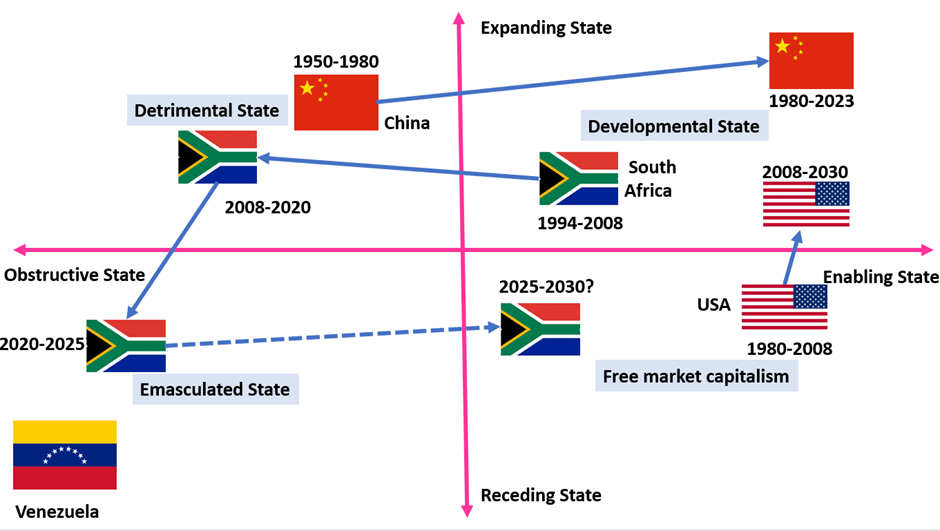
So, here’s a handy way to think about the government’s role: picture two axes. Horizontally, you have whether the state is an enabler or an obstacle. Vertically, you’re considering whether the government is growing or shrinking. When you combine these two axes, you end up with four quadrants.
First up, is the top-right quadrant. This is where the state is both an enabler and expanding. For every tax dollar it takes and spends elsewhere, it generates more than one dollar in national income. In this scenario, the state fosters value creation. We call this a “developmental state,” and it’s something our government and my students admire.
Now, let’s move to the bottom-right quadrant. Here, the state contracts, but it still plays a role in enabling things. It essentially lets the private sector do its thing. The natural tendency for government is to grow, so this state of affairs usually only happens with some idealistic intervention. The era of Ronald Reagan might come to mind here, with his famous quote, “The most terrifying words in the English language are: I’m from the government and I’m here to help.” I like to call this the “free-market capitalism quadrant and I have to confess I have a personal affinity for this quadrant. But we must admit, the lack of regulatory oversight during this phase contributed significantly to the 2008 global financial crisis, leading to a backlash against this model that’s still echoing worldwide.
Now, onto the top-left quadrant. Here, the state is growing but also being obstructive. It’s squandering the tax income it receives and destroying value. We refer to this as the “detrimental state.” In this scenario, state services and infrastructure decline, and economic growth takes a hit. The services promised by the constitution often remain undelivered. In the long run, this isn’t sustainable, and it tends to lead to the bottom-left quadrant if things don’t improve.
Finally, the bottom-left quadrant is characterised by an obstructive state and a shrinking government. The government is compelled to scale back due to overspending, bankruptcy, incompetence, and corruption. It runs out of money, and the costs of servicing debt become crippling. The state’s influence and power dwindle, and ironically, the private sector can step in because the state is so inept. We call this the “emasculated state.”
South Africa’s trajectory over the last 30 years is plotted on the featured matrix. For the first 12 years of the democratic era, South Africa had an enabling government and enjoyed good economic growth and improving standards of living. Then starting in 2008 Jacob Zuma enabled the state capture and corruption era and the state became obstructive and the financial position of the country as well as its basic infrastructure deteriorated. This was the detrimental state era.
Then, in 2018, Cyril Ramaphosa became president, and many hoped for a return to the top-right quadrant. Sadly, that hasn’t happened. Instead, we’ve slipped into the bottom-left quadrant. Economic growth has stalled, debt levels have soared, and the government’s income isn’t enough to keep expanding. We’re now in the era of a shrinking state, and while the government may pass laws and announce grandiose plans, like smart cities and bullet trains, its declining capabilities make it unable to put them into action.
So, how bad is this situation? Well, it’s pretty tough for the poor. Their constitutional rights remain unfulfilled, and the state still hinders progress – for example, by reminding citizens that fixing potholes is illegal. Are people paying attention? Not so much.
However, South Africa has a resilient and innovative private sector and civil society. They’re increasingly working around an inept and corrupt government. Security, healthcare, and education, for those who can afford them, have already been privatised. Gated communities that provide additional services like electricity, water, and sewage treatment are on the rise. However, there’s still a long way to go. Solving issues like water provision isn’t always straightforward at the local level, and state water services have already collapsed in some areas, like the Kwazulu Natal South Coast. So much for the idealistic constitution that guarantees the right to water as a basic human right. For the less fortunate, they find themselves without running water, reverting to a preindustrial age.
Though all this might sound depressing, there is a silver lining. As the state continues to falter, the private sector is stepping in to solve problems and gain more influence over an inept, incompetent, and shrinking government. It’s possible that South Africa’s future trajectory could land us in the bottom-right quadrant as power shifts to the private sector. That’s a reason to be optimistic.
Where do other countries fit on this matrix? I have had a stab at plotting the United States and China on the matrix but, dear readers, some of you who are more knowledgeable than me might be able to do a better job than me. I look forward to your thoughts.
I want to express my gratitude for all the ideas and comments received. I genuinely appreciate them, and please continue to share your thoughts.
Regards
Bruce
 Ruminant Pink Friday