
Aweh dearly beloved fellow ruminants & groupies
Veganism is so last season. If you want to get noticed at the trendiest coffee bars over a skinny decaf almond milk latte, then decarbonisation is the new veganism. For those of you who have been hiding under a rock decarbonisation is the process of reducing or eliminating carbon dioxide (CO2) emissions, particularly from human activities such as burning fossil fuels, to combat climate change and promote a cleaner, more sustainable environment.
The high priests of decarbonisation reside at the United Nations Framework Convention on Climate Change (UNFCC). The Paris Agreement, established by the UNFCCC in 2015, aims to combat global climate change by limiting global warming to well below 2 degrees Celsius above pre-industrial levels, with efforts to limit it to 1.5 degrees Celsius. A cornerstone of the agreement is the voluntary contributions, known as Nationally Determined Contributions (NDCs), from individual countries. These contributions outline specific plans and actions tailored to each nation’s unique circumstances. This collective international endeavour demonstrates a commitment to cooperation and sustainable action to address the urgent challenges of climate change.
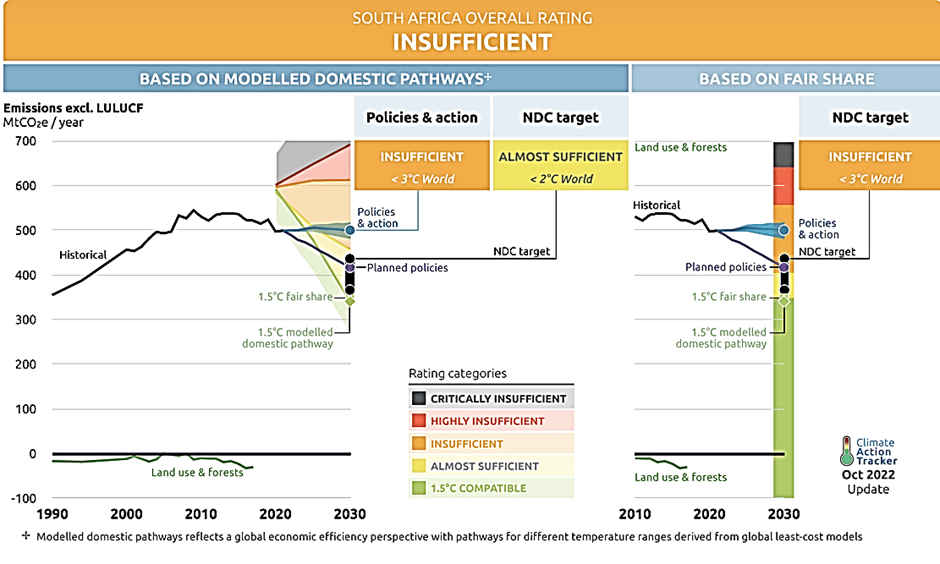
So, how are we doing? To measure each country’s performance, an independent scientific project known as the Climate Action Tracker has been established. It’s a bit like the scale lurking in your bathroom ready to tell you the harsh truth about your weight. So, let’s start with South Africa which is shown in the featured image. Taking a closer look, our nation’s efforts have been deemed “insufficient”. As things currently stand, carbon emissions are not anticipated to decrease significantly by 2030. Although emissions are not rising, this situation owes more to the challenges faced by our state-owned electricity supplier, hindering their ability to generate sufficient power to meet demand, rather than our adherence to the Paris climate goals.
But if you look at South Africa’s planned policies the forecast looks much better. So, we have good policies and plans. Does this mean the solution is at hand? Not so fast. Let’s dig a little deeper here and go to the academic literature and look at a paper evaluating South Africa’s decarbonisation performance. This quote is sufficient to get the gist of the paper, “South Africa’s co-ordinating climate institutions were able to undertake important economy-wide initiatives over the decades, developing the Peak Plateau and Decline trajectory and proposing a full policy suite: two economy-wide instruments and flagship programmes in various key sectors. The Department of Environment has ramped up its capacity significantly over the past decade to respond to the climate change agenda. As such, South Africa is both ambitious and unusual as a developing country. However, a closer look reveals that this institutional form is a necessary but insufficient response to the governance challenge of scope and scale. South Africa’s institutional co-ordination across government is superficial. Instead, different departmental efforts are subjected to deep mutual mistrust. Treasury and the Department of Environment have two different economy-wide measures reflecting their radically different cognitive orientations and have not been able to reconcile them. Even more critically though no climate institution has yet been able to impose losses on the electricity sector incumbents or govern the country’s inevitable energy transition. South Africa’s climate institutional form is therefore one that can deliver high level, internationally impressive targets, and trajectories, but, upon scrutiny, is revealed to be powerless over the country’s main emitting sector”.
So, we have a full and impressive policy suite but, that means nothing. There is no chance that the policies will be implemented. South Africa is very good at writing idealistic policies that sound good but are not grounded in political, business, and scientific reality. They belong in the fiction section of the library. When evaluating student assignments on decarbonisation, it is not uncommon for me to encounter consternation when the belief that a novel or enhanced policy will singlehandedly resolve the decarbonisation conundrum is not reciprocated. A prevailing dogma suggesting policy is the panacea for all challenges pervades our society. Evidence does not lend support to this notion. Implementing a policy represents its true value, and without practical application, even the most impressive policy remains inconsequential. The same principle extends to strategy.
Does an impressive-looking policy or strategy in addition to implementation solve the problem? Not at all. A policy or strategy that is not firmly grounded in objective reality and properly dealing with constraints, economics, political realities, and trade-offs is doomed to fail. The problem is that if you properly take all these factors into account the policy does not look as optimistic and impressive. If you can suspend reality, it is much easier to create an optimistic and idealistic policy and see this as a goal itself. Therefore, let us remember that policy and strategy, even when accompanied by implementation, may not provide a comprehensive solution to all challenges. That is how you get things like the National Health Insurance (NHI). These policies then become dogmatic religious texts and questioning them becomes an act of heresy. This applies to government policy, but it also sometimes applies to company strategies. So, dearly beloved students, readers, and groupies’ policy and strategy, even with implementation, is not the complete and sufficient answer to all problems. As unimplementable policies or strategies fail they generate their own renewal cycle and get replaced with a new often unimplementable policy or strategy. If the end goal is the delivery of the new policy or strategy this provides an endless cycle of meaningless work.
South Africa is not alone in experiencing challenges in achieving effective decarbonisation implementation. Other notable countries, including the United States, European Union, India, and China, find themselves classified as either insufficient or highly insufficient. As the Paris Agreement, in force since 2016, is intended to undergo periodic updates every five years, an overdue opportunity for a new agreement looms ahead.
So, what is now required? Of course, the answer is simple we need a new and much better agreement and policies. A big group of eminent subject matter experts is required. A large project with a generous budget and lots of travel and almond milk lattes is required. A nice location is needed. The Honolulu agreement of 2024 will solve the decarbonisation problem. In such a venture, my services stand at your disposal.
Thank you for all the ideas and comments. I really appreciate them and please keep them coming.
Regards
Bruce
 Ruminant Pink Friday