
Aweh dearly beloved fellow ruminants & groupies
For many years my wife, Nerine, said that I lived in a bubble disconnected from the South African reality living in a corporate world that operated in the global arena. Well, that has changed. In the last year, I have been involved in volunteer work at a secondary school in an underprivileged area and I have been dealing with post-graduate students and my comfortable bubble has been well and truly popped. And then, of course, there is electricity and there is no hiding from that.
I assumed that most post-graduate students at a business school would have a similar worldview to mine. Not so much. So, what is my worldview? Of course, it is complex and subject to cognitive dissonance but let me start by saying that I have been reading the Economist every week for more than thirty years. I grumble about the expensive subscription fees, but I pay them. Although I don’t agree with everything it publishes it is probably fair to say that if I were to choose a single newspaper that most closely aligns with my own worldview this would be it. Many of my students appear to form their views by reading South African government policy documents.
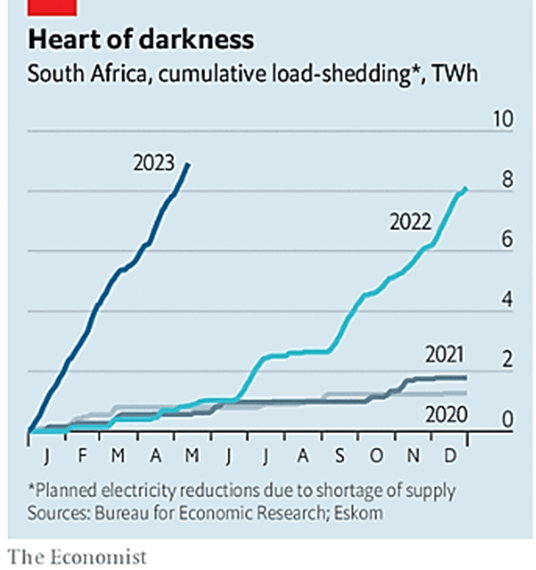
For the last few months, the Economist has been largely silent about South Africa. Although South Africa looms very large in my life there is a lot going on in the world and South Africa is just not that significant in the global arena. But this week they published an article entitled, “Business leaders fear that South Africa could become a failed state” Here we have the Economist, which is not prone to exaggeration using the contentious term failed state. Three problems are highlighted: electricity, logistics, and crime. The featured graph showing the evolving electricity crisis illustrates the problem very clearly. Prior to 2022 load shedding could be considered an occasional annoyance now it dominates everything with no power for 6-10 hours per day, every day, and it is forecast to get worse by Eskom the state electricity supplier. The secretary general of the governing ANC, Fikile Mbalula, has said that load shedding will be solved by the end of the year. He is a liar or alternatively willfully ignorant, which is worse, and is contradicted by members of his own party.
Electricity used to be something I took for granted but not anymore. In our case, we reluctantly installed an expensive solar photovoltaic (PV) system in February with lithium batteries, and we no longer experience load shedding in our house. I am called the solar system zealot as I manage the system and can analyse what is happening on a real-time basis with an App on my phone. Apart from using less electricity from Eskom we are now also using electricity much more efficiently in our house. The only real inconvenience is that the electric oven is not connected to the solar system, but the air fryer and microwave can still be used. We no longer heat our house with electricity and heating this winter uses gas, LPG, and wood. Our carbon footprint has declined significantly, and we are doing our bit for decarbonisation. It is very easy to waste energy and electricity if it is cheap and always available. Load shedding has had the unintended consequence of decarbonising the Young household. However, we are part of the privileged elite. Most South Africans cannot afford an expensive solar PV system. They are decarbonising simply by not having electricity.
South Africa is now facing an existential crisis. Business has responded by stepping in to assist the government. But the Economist states that cabinet ministers are inherently skeptical of the free market and are statist. Therein lies the rub. This is a polite way of saying that government is hostile to business. Our cabinet minister’s worldview does not come from reading the Economist to the extent that they are educated and read at all. Am I exaggerating? Well, let’s explore this theme a bit more.
Let’s start with the South African chicken industry which is the staple protein of South Africans. Astral, the largest chicken producer in the country is now struggling to survive and barely making money. It is spending heavily on supplying its own electricity and also its own water and this has severely crimped its margins. Is the government sympathetic and helpful? Not at all. The competition commission has accused it of excessive pricing and has instituted an investigation into excessive pricing in the chicken industry.
Let’s now turn to the South African automotive manufacturing industry which employs 110 000 people directly and up to half a million if you consider the multiplier effect. The global trend to battery electric passenger vehicles is gathering momentum and South Africa currently exports most of the vehicles it manufactures. Is the government assisting the local industry to transition to the coming era of battery electric vehicles? Not at all. Much to the frustration of automotive industry executives the government is dithering and stalling on BEV policy. The future of this vital industry in South Africa is at risk.
As a final example let’s consider the declining South African mining industry. The policy perception index of the latest edition of the Fraser Institute’s Annual Survey of Mining Companies ranks South Africa 53rd out of 62 jurisdictions. The government since 2008 has been pursuing the implementation of a regime geared towards expropriation without compensation and transformation. This disincentivises investment and skills development, adding to South Africa’s risk premium. The global mining giants have been disinvesting from South Africa in the last decade.
How do I personally experience the South African government? I have previously written about what it is like to renew your driver’s license in South Africa. Let me relate just one new lived experience to use the fashionable terminology. In April 2021 I accepted a voluntary retrenchment package from Sasol, my employer of 30 years. In terms of South African law, I am entitled to a payment from the state Unemployment Insurance Fund (UIF). As required by the law I have contributed insurance premiums to this fund my entire working life and continue to do so today. My claim was duly submitted in June 2021 with all the supporting documentation. Eleven months later my claim was rejected. No reasons were given, and no attempt was made to communicate with me. I appealed the decision in July 2022. In September 2022 my appeal was approved. Have they paid me? No. Fortunately for me, my nephew, George Kahn, is a human rights lawyer working for the highly respected human rights legal firm Richard Spoor Inc. He is trying to help me. He spends a large portion of his life trying to extract money from the government for things like UIF and workman’s compensation for poor and indigent people. It is horrifying and deeply depressing to listen to his stories. The UIF has acknowledged they owe the money, but they have not paid me because of a “systems error”. If they don’t pay the next step would be to get a court order instructing them to pay. In other countries that would be that and I would get paid. Not in South Africa. George relates the depressing reality that the Department of Labour under which UIF and workman’s compensation falls routinely ignores court orders. I might never get paid. The rule of law in South Africa is breaking down and government departments and municipalities do as they please.
Ann Bernstein of the Centre for Development and Enterprise (CDE), a think tank, suggests that South African business has a case of Stockholm syndrome and are helping to cover up for a failing government. It is very understandable that business offers to roll up its sleeves and assist the government but there comes a point where business is enabling a failing government to continue. Is further appeasement a failing strategy and is a confrontation ultimately required? Where does further appeasement lead?
One option is to run away. I am now watching friends and colleagues who have spent their entire lives in the country cutting their losses and packing up their things and leaving. We are advising our boys that they need to consider a future outside of South Africa. Will Nerine and I remain in South Africa? Dearly beloved readers you are wiser and more knowledgeable than me. What is your sage advice?
Thank you for all the ideas and comments. I really appreciate them and please keep them coming.
Regards
Bruce
 Ruminant Pink Friday
The ANC is a party of incompetent corrupt, racial socialists. Corruption is not a bug but a feature. It enables the flow of funds that enable them to buy elections and paradoxically give hope to the unemployable masses….you too can win the lottery of corruption.
The problem of overseas is that they are clever efficient corrupt globalists, who are leading the , sorry have ld the world to the brink of nuclear catastrophe. Butdont worry you still have the game shows and soapies on the box.
which is worse dumb people , or clever people doing the wrong things. Your choice.
PS in a nuclear war apparently George is the best place to be.
LikeLike