

Aweh dearly beloved fellow ruminants & groupies
176/333 days of load shedding in 2022 – currently stage 6
In 2023 I have teaching duties and for my sins, I am going to be teaching a course on sustainability and energy and I am frenetically busy preparing the course material. So, today, as I must, I return to the energy and climate change topic after the recent 2022 United Nations Climate Change Conference in Egypt known as COP27. Climate change is probably the biggest topic when it comes to energy and sustainability. We can start the discussion by noting that in 2021, after a temporary Covid 19 induced dip, global CO2 emissions rebounded to their highest levels in history. My best guess is that when 2022 is done it will be another record and my learned forecast is 2023 will be even higher.
But aren’t we supposed to be reducing CO2 emissions? Yes, of course, but not just yet. The intergovernmental panel on climate change models (IPCC) models require carbon emissions to be cut by 50% by 2030 for the world to achieve a 1.5 oC temperature rise target. The panel still wants to achieve this target and says organisations need to provide annual performance reports in straightforward language and focus on absolute emissions. Eight years to go.
Carbon pricing is an important approach to reducing carbon emissions (also referred to as greenhouse gas, or GHG, emissions) that uses market mechanisms to pass the cost of emitting on to emitters. This is done either by imposing a carbon tax that puts a direct price on GHG emissions and requires economic actors to pay for every ton of carbon emitted. Alternatively, an emission trading system (ETS)—also known as a cap-and-trade system—sets a limit (“cap”) on total direct GHG emissions from specific sectors and sets up a market where the rights to emit (in the form of carbon permits or allowances) are traded. The setting of the rules of the game for both options is a political process in which lobbyist groups pressure governments resulting in rules which may be too lenient, or which are constantly changing. Australia is an example of this and it is only this year that carbon emissions legislation passed through parliament.
The World Bank has recently published a good study on the state and trends of carbon pricing and it makes for interesting reading. I highly recommend reading this but for those of you not inclined to do that, I will provide a dumbed-down summary. They start with a global map showing where in the world carbon pricing has been implemented or is planning to be implemented which is copied below.
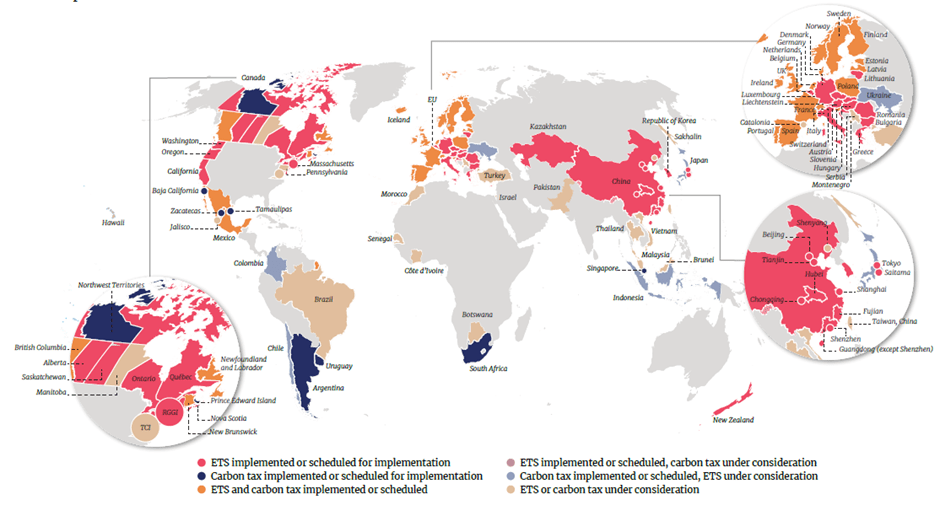
Carbon pricing currently in operation covers approximately only 23% of total GHG emissions. Let that sink in. 77% of carbon emissions are not subject to carbon pricing including large parts of the United States.
When it comes to carbon taxes South Africa has the 5th highest carbon tax in the world at R144/ton ($8.4/ton) and it is scheduled to increase at 2% above inflation every year. But there is a catch. There are many exemptions, and the carbon tax does not apply to all emissions. The most glaring exemption is South Africa’s electricity provider, Eskom, which emits 200 million tons of CO2 per year. The plan however is to start removing the exemption in 2025. So, let us just do some simple sums on what it would mean if the Eskom carbon tax exemption were removed. At current carbon tax rates, the carbon tax would amount to R101 billion ($5.9 billion) per year. The cost of this would need to be passed on to the consumer and would entail an electricity price increase of more than 30%. To say this will not be well received is an understatement. As the 2025 deadline looms there is sure to be further intense lobbying and negotiation and perhaps further exemptions will be made.
The South African story is not unique and there are many exemptions to carbon pricing in many jurisdictions. Whichever side of the fence you sit on the profession of being an energy policy and climate change lobbyist is sure to be a growth area. Although GHG emissions have not started coming down the revenues generated from carbon pricing mechanisms are steadily increasing and approached $90 billion globally in 2021.
$90 billion is a lot of money but how significant is it? The oil and gas industry has delivered, on average, profits of about $1 trillion per year and this excludes the smaller coal industry. It is perhaps only now that we are just starting to approach the threshold where carbon prices will start to have a meaningful impact on the fossil fuel industry, but it is important to note that there are still many jurisdictions where no carbon pricing applies. In order to address this carbon border adjustments is a rapidly developing field. Carbon border adjustments aim to address differences in the domestic climate policies, and the resulting emissions intensity of production, between trading partners. By accounting for these differences in climate ambition and emissions from the production of goods, carbon border adjustments are designed to protect industrial competitiveness and avoid shifting production — and emissions — to countries with dirtier processes or weaker environmental standards, which is known as carbon leakage. This is still a developing policy area, and it remains to be seen how effectively this will be implemented and applied across the world. Expect this to be a complex political process with many lobbyists.
There is a trend to increase implementation of carbon pricing and of coercing those not cooperating, but it is a slow political process with many vested interests and a great deal of complexity.
So, what do I think? Given this backdrop, I would suggest we have global cognitive dissonance (holding two contradictory beliefs at the same time). On the one hand, we believe that we should reduce GHG emissions by 50% by 2030 (or 2035) but on the other hand, we are not prepared to face up to the complex trade-offs and sacrifices that would need to be made. A couple of decades ago GHG emission reduction was not a serious topic but over the last decade, this has become a very serious topic. We know that in the long term there may be serious and unpleasant consequences but in the short term, there may be unprecedented opportunities for profit and for bonuses to be paid.
Thank you for all the ideas and comments. I really appreciate them and please keep them coming.
Regards
Bruce
 Ruminant Pink Friday