
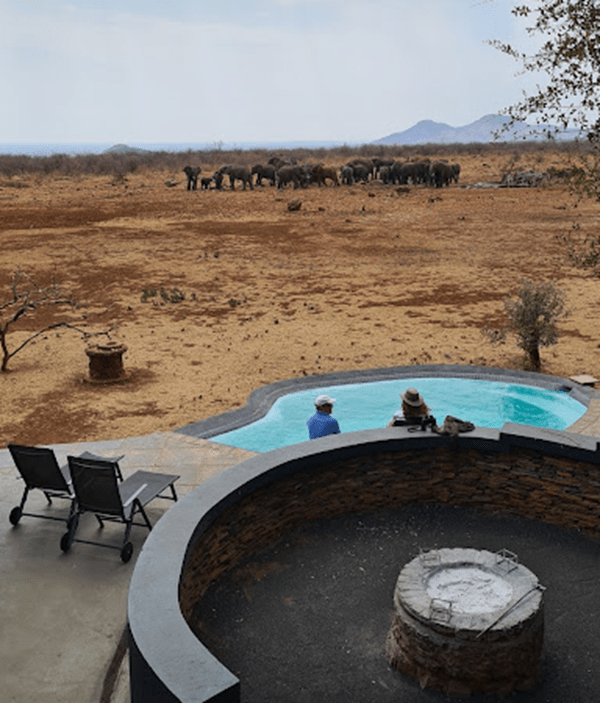
Madikwe Mooifontein Camp
Aweh dearly beloved fellow ruminants & groupies in day 85 of no lockdown.
Period as an ivory tower academic 91 days
Last week there was no blog. I was in the beautiful game reserve Madikwe from Thursday to Sunday with a group of friends. It was a fantastic trip. The weather was unusual for this time of the year. A cold front lingered the entire long weekend and it even rained. It was very cold. The bush was beautiful and there was abundant healthy-looking game with many juveniles and abundant birdlife. The reserve is flourishing.
On Friday the country moved into stage 4 load shedding with the trigger event being unprotected industrial action at some of Eskom’s power stations. The much bigger problem is the poor state of South Africa’s electricity generation infrastructure. Stage 4 means three two-hour power cuts per day. The camp has a diesel generator but, unsurprisingly, it cannot cope with the full load in the very cold weather. Hot water, heating the rooms, the electric stoves, and ovens were too much for the generator, so it kept tripping until the high load items were turned off. None of this was too serious and there was a fireplace and we easily coped as South Africans do. Then as elephants do one of them pushed over one of the electricity poles supplying the camp and the droning of the generator in the background became more permanent. South Africans understand and tolerate load shedding. Will foreign tourists be as understanding and tolerant? Perhaps they will just go elsewhere?
Perhaps South Africa can create a niche tourist business for people who follow the Wim Hof Method. It is apparently very healthy to take a cold shower and I have tried but then decided life is too short for cold showers in winter.
We returned home on Sunday to more stage 4 load shedding. So far this year we have had 929 hours of load shedding out of 4296 so far which is 22% of the time. This is the worst ever and it is getting worse. Only once before have we faced stage 6 load shedding but now it has happened again. Eight hours of power cuts per day. It is also not going to get better in the next couple of years. The reasons for this are well documented and the performance and reliability of an ageing generation fleet has been steadily declining for the last 7 years. There is nothing to suggest that the decline will not continue for the next few years. New generation capacity is desperately required but cannot be implemented in the short term. Will the country now face this crisis and take meaningful steps to resolve this? It is uncertain. Politicians continue to dither and interfere dreaming of state control. Until recently the government would not give licenses to independent power producers above 1 MW. Only recently was this increased to 100 MW. The private sector could solve this problem but what about state control?
Our house is heated with gas, has a gas stove and hot water is provided with gas. Some of my friends have generators and others have solar panels batteries and inverters. We have an inverter with a couple of deep cycle batteries that allow us to run our router, some lights, computers, and TV. As I write this our inverter is powering my internet connection and computer. We muddle through. Perhaps we are going to need to throw some more money at this. Can you go completely off the grid? Well, yes, in theory, you can if you have enough space for the solar panels, but it is expensive particularly if you insist on powering electricity-hungry things like hot water, heating, air conditioning, stoves, and ovens. If you manage your electricity consumption down, it becomes more doable but still expensive. Also be aware that a big home electricity installation is going to require management, maintenance, and tender loving care. How much money and effort you throw at this problem depends on your means and desire to insulate yourself from load shedding. What about those people who don’t have the means to spend a lot of money on a load-shedding solution? Sorry for you.
At a household level, depending on your budget, you can try to find ways to cope but when you move beyond the boundaries of your home there is no meaningful alternative to the central provision of electricity. A modern city, like Johannesburg, is totally dependent on centrally provided electricity. Beyond stage 6 there is stage 8 and then there is grid collapse. This has never happened in South Africa, but it has happened elsewhere. If the current years-long trend is not reversed this is what is perhaps in our future.
If you have a grid collapse, you are looking at 7-10 days or longer to synchronise and restart the grid. Let’s consider this grim prospect and the consequences of a long-term grid outage event are dire. Don’t think that your home generator or solar panels will insulate you from the chaos that will unfold. With no power to supply the pumps, the water supply will stop, and sewage will back up. There will be no power to pump the fuel into cars and trucks. Food supply will break down and the cold chain will fail. Will the banks be able to handle this without breaking down? After 10 days without power, a city like Johannesburg will descend into feral anarchy and looting which the police will not be able to control. Lots of people will die. Every effort is being made to avoid this situation, but it remains a possibility.
Why is it coming to this? There is a lot of overanalysis of this problem but don’t go down that distracting rabbit hole. The answer is very simple. It is a failure of our democratically elected government which has been in power since 1994. The private sector is ready and willing to step into the electricity generation space if the government provides a conducive regulatory and commercial environment and is prepared to relinquish control. Attractive financing for renewable electricity and electricity storage is available but the government needs to step aside and get out of the way for this to happen.
It is only recently that government has, reluctantly after significant pressure was applied, allowed private generation projects of 100 MW to be considered. The 100 MW limit is arbitrary and unnecessary. The pressure needs to continue. Will it take a grid collapse to finally drive the message home? I sincerely hope not.
It is time for all South Africans to become less complacent and accepting of government failure. A reliable electricity supply is so fundamental to the future of South Africa that we risk becoming a failed state if we allow the current trajectory to continue.
The problem is not confined to electricity supply but extends to other utilities like water supply and sewage treatment. Reliable water supply has broken down in many parts of South Africa and the dire situation on the Kwazulu Natal south coast is just one example. Here tourists might have to tolerate no electricity and no shower. Even the Wim Hof supporters will not tolerate this. The tourism potential of South Africa is enormous, but no international visitor is going to tolerate this. That is our current reality.
The government has failed. Does the government accept responsibility for this? Apparently not. Why do so many people accept this? What will it take for this to change? More activism?
Thank you for all the ideas and comments. I really appreciate them and please keep them coming.
Regards
Bruce
 Ruminant Pink Friday