
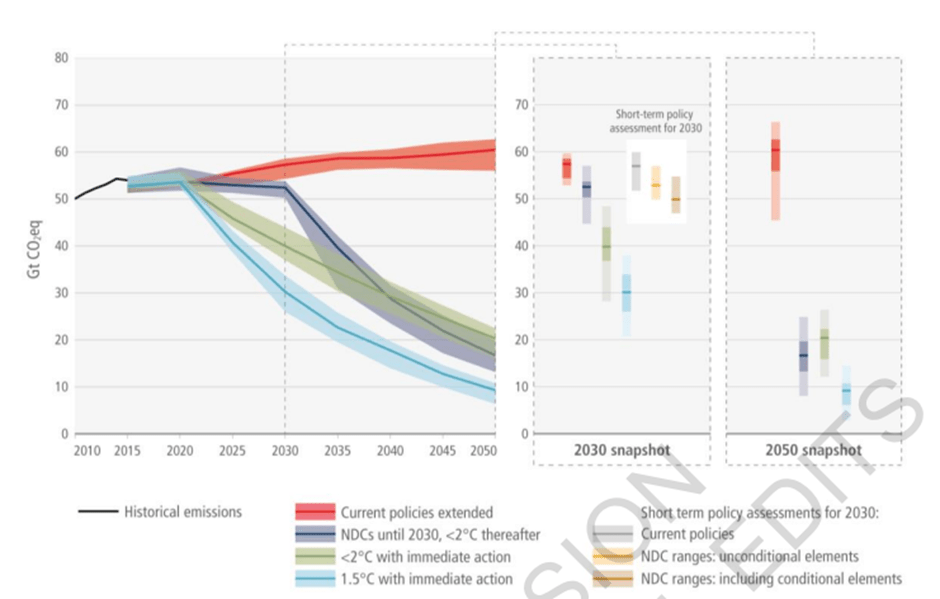
Figure TS.9 (IPCC Mitigation Report) Aggregate GHG emissions of global mitigation pathways
Aweh dearly beloved fellow ruminants & groupies on day 2 of no lockdown.
Period as an ivory tower academic 8 days
Quite a few things have changed for me over the last week. The South African Covid-19 state of emergency has come to an end after two years. Woohoo! Covid-19 has caused an official death tally of about 100 000 in South Africa with a real toll potentially three times this. I personally know several people who have died from Covid and I’m sure you do too. South Africa has experienced four Covid waves, but the latest Omicron wave has fortunately been something of a non-event. Many people got sick, but few died. It appears that the Covid 19 virus is following the path of previous viruses and is mutating to become more contagious but significantly less lethal. It’s time to move on with our lives and for once I’m more or less in agreement with the South African government. I’m very pleased I’m not living in Shanghai where the Chinese government is imposing a strict lockdown to try and eliminate Omicron. They will most likely fail.
On Monday I reported to HR at the Wits Business School and got my staff card and the keys to my new office which already had my name on the door. It’s real! I confess to some trepidation regarding whether I should have started a new job or just remain retired. However, the concept of being an academic with its associated academic freedom providing me a platform to teach and pontificate endlessly on the topic of energy will hopefully provide a new lease of life for this old dog. My academic freedom has been confirmed and I don’t need to tow any government or company line. I’m looking forward to that.
So now to the IPCC mitigation of climate change 2022 report. The Intergovernmental Panel on Climate Change (IPCC) is the United Nations body for assessing the science related to climate change. https://report.ipcc.ch/ar6wg3/pdf/IPCC_AR6_WGIII_FinalDraft_FullReport.pdf. The report is 2913 pages and 280 MB and is the final episode in an IPCC trilogy of more than 10 000 pages. In August last year, a report on the physical science basis of climate change was published. This is 3949 pages. It found that the climate was changing more rapidly than originally anticipated by climate scientists. In February this year, a report on the impacts, adaptation, and vulnerability to climate change was published. This runs to 3676 pages. It found that the consequences of the disruptions to the global climate system are also worse than expected and evaluated how much humans and the natural world could adapt to them The IPCC has issued summaries for policymakers and technical summaries.
So, what does one make of all of this? These reports have been compiled by hundreds of distinguished experts in their fields. Are the views of a relatively undistinguished ageing academic with self-diagnosed narcissistic personality disorder in any way relevant? Probably not. Will that stop me from rumination? No.
These reports are not easy reading and even the summaries are hard going. The reports cover many fields and have been written by many subject matter experts. A lot of complex modelling has been done based on many assumptions and no single person or small group of people no matter how diligent or intelligent could properly understand or interrogate all of this. The IPCC hasn’t just thrown the kitchen sink at studying this problem it has gone completely ballistic. The Zondo reports are light loo reading compared to these reports. You could spend years delving into the detail and never surface again. For those of you who enjoy detail and interesting reference material, the reports are a treasure trove.
For today’s rumination, I’m going to take the first two reports as given. Anthropomorphic global warming (AGW) is real, and it is having a complex and evolving impact on the earth. We should not carry on with business as usual and we should do something about it. This is what the 3rd report tackles. It is also the area where I can at least claim some experience and expertise. It is going to take the media and other experts some time to go through and study the mitigation report, but I think it is worthwhile to look at one of the key messages coming from the report.
The report emphasises that the window to meet UN climate targets of a temperature rise of 1.5 or 2 oC is rapidly closing. https://www.economist.com/the-economist-explains/2022/04/04/a-new-ipcc-report-says-the-window-to-meet-un-climate-targets-is-vanishing. To meet the goals of the Paris agreement, to limit the average global temperature rise to 1.5°C above pre-industrial levels—and failing that, to below 2°C—will take immediate and unprecedented action from every country. This brings me to the featured image which shows four forecasts for global CO2 emissions over the next 30 years. The first (red) is a business as usual (BAU) forecast. The second forecast (dark blue) is that we continue with nationally determined contributions (NDCs) until 2030 for CO2 reductions announced prior to COP26. After 2030 there is an accelerated reduction of emissions CO2 to likely limit the temperature rise to >2 oC. In other words, we kick the can down the road for eight more years and then start CO2 reduction in earnest in 2030. The third forecast (green) shows the emissions reduction profile starting now to likely limit the temperature increase to >2 oC. This implies a more than 20% reduction in CO2 emissions by 2030 and reaching net-zero by 2070. The fourth forecast (light blue) shows the emissions reduction profile starting now to likely limit the temperature increase to >1.5 oC. This implies a more than 40% reduction in CO2 emissions by 2030 and reaching net-zero by 2050.
What is likely to happen in practice? A 20-50% reduction in CO2 emissions by 2030 would most likely trigger a global economic crisis as well as steep price increases and shortages of many essential items like food and chemicals. Home heating would need to be transformed with expensive heat pumps.
I have a background in the base chemical industry which is tightly intertwined and dependent on the oil and gas industry. I covered this in an earlier blog. https://ruminantpinkfriday.com/2021/12/09/ruminations-on-the-shell-boycott-and-human-confusion/. The $3.9 trillion pa base chemical industry relies on the oil and gas industry for its feed. This includes fertilisers for food production as well as polymers and a myriad of other chemicals such as detergents, pharmaceuticals, cosmetics, and others. If you were to do a proper audit of your, lifestyle, home, car, wardrobe, and possessions for their petrochemical content it will be a very sobering exercise even for a bearded, minimalist, vegan, Birkenstock wearing environmental activist.
In my earlier blog, I looked at the value chain of the most common plastic, polyethylene, and its raw material ethylene which is produced by steam crackers. A 20-50% reduction in CO2 emissions by 2030 would trigger a crisis in the base chemical industry. Since I know a thing or two about the chemical industry. I searched the comprehensive mitigation report regarding how it proposes dealing with steam crackers.
Buried deep in chapter 11 there is some brief discussion regarding steam crackers. On page 49 of chapter 11, there are three bullet points suggesting recycling, biomass feedstocks, and synthetic feedstocks.
Despite this being a 2913 page report the discussion on the future of the base chemical industry is speculative, cursory, and fundamentally underwhelming. Recycling and biomass cannot provide a solution at the required quality and scale and synthetic feedstocks are enormously expensive. None of these can provide a cost-effective solution at the scale required by 2030. How the base chemical industry will adapt to fossil fuels being phased out is a significant challenge. In my very humble opinion, the IPCC could do with some better subject matter experts on chemicals.
I will stick my neck out today and say that the probability that we will see a greater than 20% reduction in CO2 emission by 2030 is essentially zero. I’m happy to offer 12:1 odds on a bottle of your favourite libation (to the value of mine being Kanonkop Paul Sauer 2022), that this will not happen. To be clear you get the 12 bottles if CO2 emissions are reduced by >20% (<40 Gtons/yr) by 2030. I only need one bottle. I am a man of modest appetites. I’m not expecting any takers but just in case I will limit this to the first five applicants. Kanonkop Paul Sauer (2016) retails for R899 ($75) so I’m putting R54 000 ($3600) on the line here. This is a lot for an indigent academic. I have won a bet on GTL technology with my Sasol colleague, Theo Pretorius, which pays out in May 2026. He has 12 magnums of Kanonkop Paul Sauer (2012) stored in his cellar. So, my position is hedged.
To those of you who may wish to label me as a troglodyte or as a shill for the fossil fuel industry please go ahead but may I request that at the same time you take the wager. Don’t just shout at me put your money where your mouth is.
Now, what about a steep reduction in CO2 emissions post-2030. Perhaps that is possible, but it will not come without trade-offs and sacrifices. To what extent are people voluntarily willing to sacrifice and endure hardship in a democracy?
What happens if we exceed the temperature increase targets set by the IPCC. We are probably going to find out.
Thank you very much for your comments and suggestions and please keep them coming.
Regards
Bruce
 Ruminant Pink Friday