
Aweh dearly beloved fellow ruminants & groupies in day 722 of re-modified lockdown Level 1.
Period as a semi-retired pensioner: 350 days
Tomorrow, we drive to Southbroom so yesterday I filled my car up and it was R1 361 ($91) for 63 litres. Today the Brent crude oil price is $101/bbl. In March 2020 it was $20/bbl. For the last few months, it has been increasing every month and it is expected to go up again next month. Since I worked in the petrochemicals industry, I often get asked how I foresee the oil price in the short, medium, and long term. Here is my considered response.
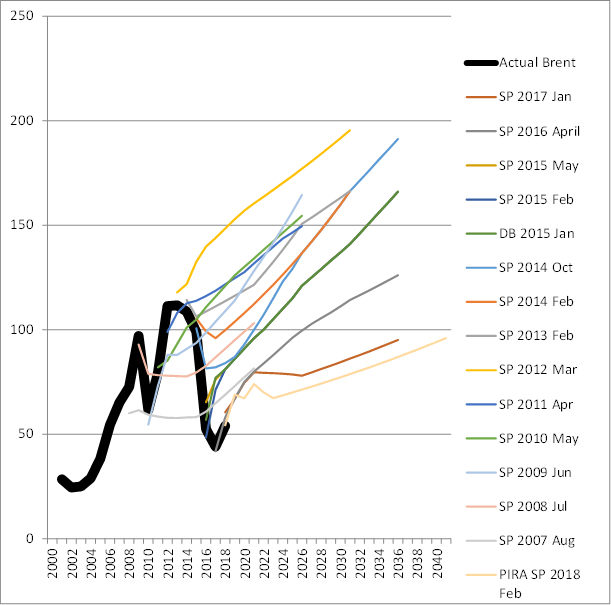
Many petrochemical companies, expensive consultants and academics devote considerable effort to forecasting the oil price. They are all very bad at it. The featured image shows the oil price forecasts of the well-known energy research consultancy Wood Mackenzie. As you can see their forecasts bear little resemblance to reality. There is nothing particularly unusual about the Wood Mackenzie forecasts. I have seen hundreds of forecasts in the past three decades and they have all been very wrong. Not even close. As we speak more forecasts are being prepared and people are paying for them. They are also wrong. For a small and very reasonable fee, I can also prepare a forecast which I will provide to you in a very beautiful and impressive 30 slide PowerPoint presentation. It will be very pretty I promise you that.
There is a very good reason all oil price forecasts are bullshit. The oil price is unpredictable. Not just a little bit unpredictable but deeply fundamentally unpredictable. Strangely enough, I sometimes got a hostile reception when expressing this view to those people paid to do this. Although to be fair some of them would speak to me quietly afterwards and agree with me but say that this is what they are paid to do, and they don’t believe it themselves.
Although there is a very extensive body of literature on oil price forecasting methodology relatively little of this literature focusses on the issue of how good these models are. Some interesting research was done by the Deutsche Bundesbank. https://www.bundesbank.de/resource/blob/703530/3b7d8adafbe1696268b58208cd18d361/mL/2009-12-08-dkp-32-data.pdf. Although this work was more focussed on shorter-term forecasting methodologies, they performed a statistical analysis on a number of what appear to be sophisticated methodologies compared with what they call a naïve random walk model. They conclude that the accuracy of all the forecaster’s methodologies is “negligible” and is not better than a no-change forecast. There is little reason to believe that longer-term forecasting methods should fare any better.
There are sound scientific reasons for this. Some phenomena can be forecasted, and some cannot. An example of something that can be forecast is the forecasting of tide tables for a given location which is based on lunar cycles. There are websites one can visit to generate accurate tide tables up to fifty years in the future and they state that the models can be improved to provide forecasts even further into the future. You can plan your surfing weekend in 2070.
Yet there are other simple models where errors rapidly propagate, and the forecasts degenerate rapidly. One can take a problem that would appear to be extremely predictable – mathematical billiards i.e., you have a table and a ball, but the ball has no mass so there is no friction. The ball bounces around according to the same rules as an ordinary ball.” That is, it moves along a straight line until it hits the edge of the table where it bounces off following the law of reflection”. Mathematicians have studied this problem only recently. [1]https://plus.maths.org/content/chaos-billiard-table. , https://www.newscientist.com/article/dn25296-billiard-table-chaos-wins-1-million-maths-prize/.
In essence, after many bounces, the position of the ball on the table is completely unpredictable and it could be anywhere on the table. It will not help much to make the model more “granular”. If you use 12-point floating arithmetic chaos will emerge after a certain number of bounces. Increasing this to say 24-point arithmetic will just delay the problem. In addition, the notion of trying to measure a starting angle to 24 significant figures is simply not possible no matter how granular you are. Unpredictability emerges from a very simple problem.
This simple model is said to display chaotic behaviour where chaotic behaviour can be defined as stochastic behaviour occurring in a deterministic system. Stochastic means random or lawless, deterministic systems are governed by exact unbreakable laws or rules. So deterministic chaos is random (or lawless) behaviour governed entirely by laws.
Although a model may be simple to formulate the issue of understanding its predictive power and understanding how errors propagate with time is not a simple matter. Economic models are often formulated on what appear to be very sound principles of modelling supply and demand to a high degree of granularity but there is often little understanding of how errors propagate over time.
Some very interesting research has been done on supply chain dynamics and how even very simple supply chain models exhibit (deterministic) chaotic behaviour. Chaos arising from the beer game has been studied and documented. https://www.researchgate.net/publication/241600599_The_supply_chain_complexity_triangle_Uncertainty_generation_in_the_supply_chain. The game shows how the inter-relating feedback loops within the supply chain give rise to complex behaviour within what seems to be a very simple business system. The game is run with four teams of participants each team is a company within the supply chain i.e., a retailer, wholesaler, distributor, and factory. A team of researchers based at MIT investigating managerial decision-making behaviour have found that participants apply simple rules for making ordering decisions when playing the game. It has been found by the analysis of many runs of the beer game that participants vary slightly in the application of the rules. For example, some participants take into account all the inventory in the supply line while others ignore it altogether or forget it occasionally, participants may have a slow response to inventory fluctuations away from their desired level while others may respond fast and try to achieve their target more aggressively.
It has been subsequently possible to analyse and simulate the decision rules made to find which rules are the most effective. It was recognised that generally simulations were run over a short period of time, say 60 weeks. This time period is less than the fundamental period of the system and therefore will not reveal the existence of complex modes of behaviour within the system. It has been found that within the simple model outlined above one in four management teams in the supply chain create deterministic chaos in the ordering patterns and inventory levels. This produces costs to the system that are considerably sub-optimal, exceeding the minimum possible costs by over 500%. The results also showed that the slightest change in policy could result in a stable output flipping into the chaotic region, i.e., a transcription error when inputting an order, the order being delayed in the post, a manager forgets something or inputs it a day late, all these everyday seemingly inconsequential delays or errors can have a dramatic and costly effect on the management of the supply chain.
In the history of science, the question of scientific determinism dates back several hundred years. The famous French scientist Pierre Laplace postulated scientific determinism based on classical mechanics. The relevant quotation from Laplace is as follows:
We may regard the present state of the universe as the effect of its past and the cause of its future. An intellect which at a certain moment would know all forces that set nature in motion, and all positions of all items of which nature is composed, if this intellect were also vast enough to submit these data to analysis, it would embrace in a single formula the movements of the greatest bodies of the universe and those of the tiniest atom; for such an intellect nothing would be uncertain and the future just like the past would be present before its eyes.
This super-intellect is known as Laplace’s demon. Thus, according to scientific determinism, the future is forecastable to an arbitrary degree of accuracy if one puts enough effort into it. If the model is sufficiently granular and with sufficient computing power, then forecasts of anything are in principle possible. Chaos theory which has been described here is only one of the more recent refutations of Laplace’s demon. Thermodynamic irreversibility and quantum mechanical irreversibility were the initial refutations proposed. More recently mathematical refutations of Laplace’s demon have been published by the mathematician and computer scientist David Wolpert who has put forward a formal argument to show that it is in principle impossible for any intellect to know everything about the universe of which it forms a part.
So, what can you say about the oil price? Firstly, you can say that the oil price is volatile. In September 2020 the Economist wrote, “the oil price has swung by over 30% in a sixth-month period 62 times since 1970”. https://www.economist.com/leaders/2020/09/17/is-it-the-end-of-the-oil-age. Since then that number has gone up. Secondly, you can probably say that the oil price will mostly be in the range of $20-200 $/bbl in the next 10 years. The longer the oil price stays high the bigger and more likely there will be a crash in the price and vice versa. Just can’t say exactly when.
If you need more accuracy and predictability than that I repeat my offer of producing a beautiful PowerPoint with precise and non-volatile predictions for a small fee. If my prediction turns out to be wrong, I can prepare you another one for another very reasonable fee. If I do this often enough one of them might be quite good.
Thank you very much for your comments and suggestions and please keep them coming.
Regards
Bruce
 Ruminant Pink Friday
One thought on “Ruminations on the Oil Price”