
Period as a semi-retired pensioner: 316 days
My name is Bruce, and I am an engineer. I have worked with numbers my whole life. I can recite the first 8 digits of π and the first 10 of √2. I never specifically tried to learn them but as a student, I had an HP 41c calculator and saw these numbers displayed so often that I remembered them and have never forgotten them 40 years later. This doesn’t help me to find my glasses, phone, or keys which I had five minutes ago.
When I was an undergraduate there was a legend that an older student, Adrian Ferramosca, who according to whispers in the nerdy corridors of the chemical engineering department, apparently knew π to several hundred places. I never tested him and have not seen him since then but looked him up on LinkedIn and I think it is fair to say that he appears to have done more number-crunching than me during his career. https://www.linkedin.com/in/adrian-ferramosca-23672917/. It is also, unfortunately, the case that reciting the first 100 digits of π is not really a great chat-up line in a bar.
The world record for reciting the digits of π is 70 030 and took 17 hours to recite. https://www.pi-world-ranking-list.com/?page=lists&category=pi. Believe it or not, there is a ranking list of π memorisation and all it takes to get onto this list is to memorise the first 20 digits. Perhaps I can aspire to this one day when I am watching some paint dry.
At the one end of the spectrum, there is South Africa’s former president who represents complete and utter innumeracy. He never learnt to count. This was one of the contributing factors to the nine wasted years of his presidency. Numeracy matters. At the other end of the spectrum, there are people who know π to thousands of digits. How useful is this?
When going out for dinner with friends and the time comes to calculate the tip and split the bill it is interesting to contrast my approach with that of my accountant friends. They fire up their calculators, calculate the tip precisely and announce that each couple must contribute R837.56. If I get the job, I am much too lazy to do that. I approximate the tip very quickly in my head and round it up to the nearest 100 do the division in my head and provide a round number such as R850 and we all forego R12.44 which goes to the waiter.
There are many articles lamenting the poor state of numeracy in the general population and the situation in South Africa is very bad. https://businesstech.co.za/news/government/455406/the-shocking-state-of-maths-and-science-education-in-south-africa/. Numeracy skills are essential for innovation and economic growth but how numerate do you need to be?
I do not argue with the conventional wisdom that numeracy is important and science, maths, and engineering education up to undergraduate level is important but sometimes beyond that academic scientists and engineers often go deep into the weeds and never come out. In the case of maths and the pure sciences that is perhaps a good thing in the name of scientific progress even though there appears to be no practical application of their work. It is often the case that the application lags the pioneering work and number theory for example only later found application in cryptography.
However, when we tackle complex multi-disciplinary problems such as climate change where there is time pressure an idiot savant on number theory could be of no use. A climate science guru may be useful but if all they know is climate science then they only see one small part of the problem. Good leadership and innovation in this area requires numerate generalists. Academic engineers and scientists specialising in niche areas such as the electrolysis of water to make green hydrogen or direct air capture become too vested and biased in their niche area to be able to stand back and look at the big picture in an unbiased way. If there is time pressure to make progress on the road to net-zero more unbiased generalists are required than experts in narrow fields which may ultimately not be part of the solution.
For a leader, it is more important to understand many things at a high level than one or two things at an excruciating level of detail. The generalist leader needs to be able to explain things in a very simple manner. Here I will reference one of my favourite geeky mavericks. The recluse, David Deutsch, one of the pioneers in quantum computing. He argues persuasively that it is a scientific explanation that is a key ingredient to human progress. Prior to the industrial revolution and in the dark ages, humanity made very slow progress because we relied on myths and the authorities to order our world. https://www.ted.com/talks/david_deutsch_a_new_way_to_explain_explanation?language=en.
Deutsch provides a wonderful example of explaining the seasons. Prior to the scientific revolution, we had no proper understanding of why there are seasons other than myths. Science revealed the devastatingly simple testable explanation that the earth rotates around the sun and that the axis of rotation is tilted at 23.5o. For half the year the northern hemisphere is tilted towards the sun and for half the year it is tilted away. The southern hemisphere faces the exact opposite and so its seasons are reversed. That explains it.
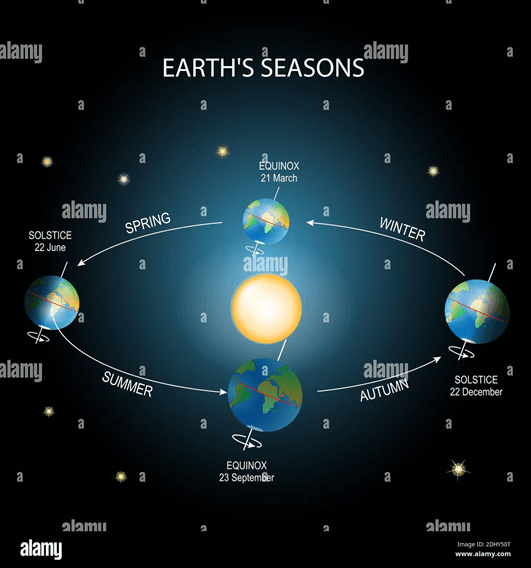
The featured image provides a sufficient and elegant high-level explanation for a numerate generalist to understand the seasons. For the idiot savants who need much more precision this is just the beginning and there are many details that make modelling the seasons accurately over long periods extremely complex. The earth wobbles on its axis, the sun doesn’t provide a constant output, and the rotation of the earth is slowing down amongst several other complexities. Many PhDs can study all these details, but the generalist can move on and think about other things. The truth consists of hard-to-vary explanations about the physical world that can be tested.
It is not the subject matter experts who should make the decisions but the generalists after listening to different experts. Too much numeracy doesn’t help.
I would suggest that there is a Goldilocks amount of numeracy that leaders need. People on the extreme end of the numeracy spectrum have the makings of gurus and subject matter experts on narrow topics but sufficiently numerate generalist leaders are essential to tackling climate change. Beware of the subject matter experts in narrow fields. They have blinkers on.
Thank you very much for your comments and suggestions and please keep them coming.
Regards
Bruce
 Ruminant Pink Friday