

Period as a semi-retired pensioner: 309 days
Today’s rumination is about how different people deal with being wrong and how other people deal with the person in the wrong. If we disagree, how should we disagree?
Being wrong is not reserved for stupid people of low intelligence. It is often the case that highly intelligent talented experts can be wrong and that they stick to their guns no matter how overwhelming the evidence is that they are wrong.
I have chosen the brilliant award-winning physicist, Fred Hoyle, to illustrate this point. Although Hoyle was brilliant, he was also rude, blunt, and argumentative. (I know a few people like that). Fred Hoyle, Willy Fowler, and Subrahmanyan Chandrasekhar did pioneering work on the structure of stars, Fowler and Chandrasekhar won the Nobel prize for this work in 1983. Of Fowler’s own close collaborator, Fred Hoyle – who had led their joint research work – there was no mention. https://www.theguardian.com/science/2010/oct/03/fred-hoyle-nobel-prize#:~:text=In%20careful%20tones%2C%20a%20member,system%20and%20universe%20are%20made.
He could be cantankerous and opinionated and had offended many influential colleagues unused to his Yorkshire bluntness. He had called some of them liars and cheats in public, while his beliefs, in later life, verged on the lunatic. He said Earth was being constantly bombarded by microbes from outer space and that these were responsible for outbreaks of flu and other illnesses. He also claimed that the remains of archaeopteryx – the British Museum fossil that demonstrates the early link between dinosaurs and birds – were fake. Such notions went down badly in scientific circles.
But were they grounds for refusing Hoyle a Nobel prize? Understanding the origin of the elements was a major intellectual breakthrough. Who cares if he was a bit fruity about flu and fossils? Hoyle was also a proponent of the steady-state theory of the Universe even as overwhelming evidence mounted for the big bang theory which he never accepted, and he stuck to his guns until his death.
In the world of today would Hoyle be subject to no-platforming? For those of you who don’t know no-platforming is defined as the action or practice of preventing someone holding views regarded as unacceptable or offensive from contributing to a public debate or meeting.
A recent and topical example of no-platforming are the recent events surrounding the popular podcasts of Joe Rogan on Spotify who interviewed the controversial (and wrong) anti vaxxer Covid vaccine scientist Robert Malone on 31 December 2021. The musician Neil Young (no relation) has withdrawn his music from Spotify in protest. A group of 270 doctors, healthcare workers, educators, and scientists are campaigning for Spotify to publicly adopt a misinformation policy. https://www.rollingstone.com/culture/culture-features/spotify-covid-warning-doctors-joe-rogan-misinformation-1292813/. Really!
Having been a corporate drone for three decades and being the victim of complex, ever-changing, often incomprehensible corporate policies this will serve to stifle dissenting views in their tracks. The policy will need to become ever more complex over time as loopholes are closed and exceptions dealt with. Then only experts will understand the policy and soon all staff will be subjected to deadly annual compulsory internal 3-day training courses. There will of course need to be many committee meetings and the content will need to be scrutinised by newly hired bureaucrats generating an ever-growing library of reports documenting accepted orthodoxy. A growing content nanny department/bureaucracy will develop a life of its own. Getting approval to interview anyone even slightly controversial will take months and lots of work. Spotify will need to become more expensive to cover these costs. It will usually just be easier not to consider anyone even vaguely controversial.
Let me now turn to Robert Malone. He is a distinguished scientist with impressive credentials, and he has done impressive research relating to mRNA vaccines. At the same time, he holds some wacky and wrong views regarding vaccine safety. https://en.wikipedia.org/wiki/Robert_W._Malone . A modern Fred Hoyle although I daresay less distinguished than Hoyle.
So, what to do? A first and simple step is a disclaimer by Spotify that the views expressed on interviews published by Spotify do not necessarily represent the views of Spotify and that it is incumbent on the listener to form their own views by evaluating different points of view as well as the evidence. If the listener finds the interview content offensive, they may feel free to utilise the off button. In other words, treat the listeners as adults who don’t need a nanny. A second step is to encourage interviews and debates with other experts where there is dissent. If a particular interview creates dissent, then encourage dissenting interviews and debates where wrong ideas can be debated, rebutted, and scrutinised. More controversial interviews not less.
We find ourselves in an increasingly intolerant world where people with dissenting views are effectively shouting at each other when they engage if they engage. Stifling dissenting views is serving to create the polarised and divided world we live in.
How should we disagree? One of my groupies sent me this pyramid outlining Graham’s hierarchy of disagreement for debates. Paul Graham published an essay on his blog on how to disagree. http://www.paulgraham.com/disagree.html. More detail is provided here. https://bigthink.com/personal-growth/how-to-disagree-well-7-of-the-best-and-worst-ways-to-argue/.
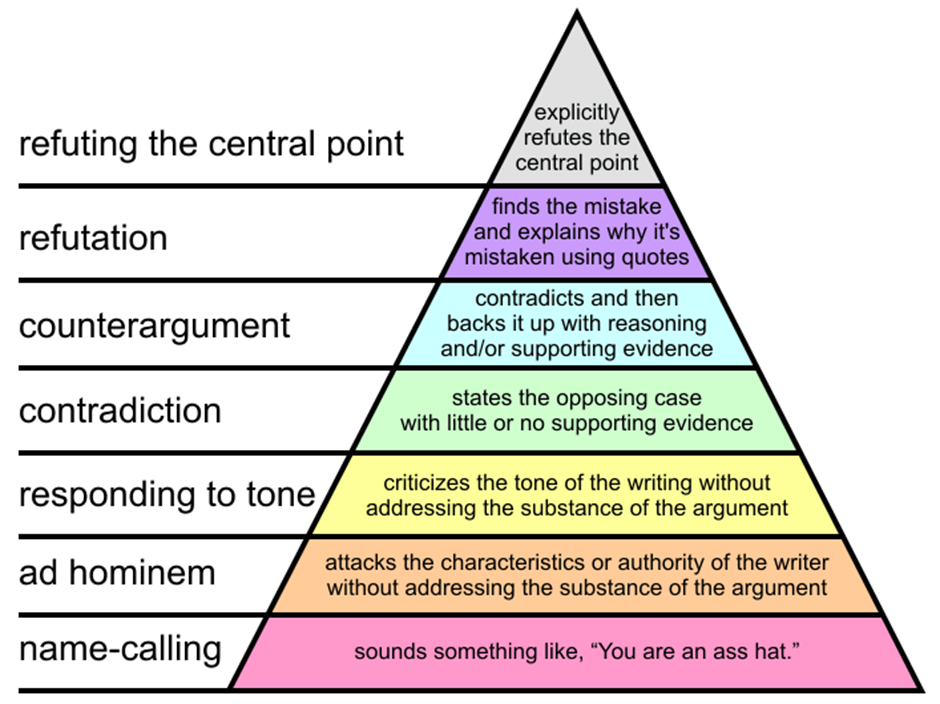
A good interviewer can act as a mediator and facilitator and can intervene to issue warnings and a yellow or red card if there is repeated behaviour at the bottom of the pyramid. If a tennis umpire can maintain the discipline to get a match between two ill-tempered players completed, then there is no reason a good interviewer could not conduct a constructive interview and debate and allow differing points of view to be aired and critiqued.
No-platforming is not the answer and is a form of bullying and a tool used to promote orthodox thinking. It is also the case that intelligent, brilliant, and creative people can also be egotistical, rude, offensive, and sometimes wrong. Sometimes however they are right and are worth listening to. Denying them a platform is wrong.
In several previous blogs posts, I have discussed some thinking and concepts from the controversial psychologist Jordan Petersen. He has been involved in several controversies. He is a controversial person. Recently he was interviewed by none other than Joe Rogan where he veered off into the weeds regarding climate change and climate modelling. https://edition.cnn.com/2022/01/27/us/joe-rogan-jordan-peterson-climate-science-intl/index.html. He has faced withering and justified criticism from climate scientists. Let’s see how he responds to this. Jordan Petersen still has a lot to learn about climate science and his ignorance on this topic has been revealed.
Does this mean that everything that he has done is wrong? Does this mean he is a bad person to be shunned? Of course not. I think that his ideas about speaking your truth are profound and are directly applicable to how he should respond to the latest controversy. https://ruminantpinkfriday.com/2021/02/24/articulate-your-truth-or-pay-the-price/.
There is a lot of value in unconventional people with unconventional ideas and they may often be disagreeable and unlikeable. They can also often be wrong but sometimes they are right. Cancelling them is profoundly wrong and severely diminishes intellectual progress which often comes from the fringes of society and not from the orthodox mainstream.
Thank you very much for your comments and suggestions and please keep them coming.
Regards
Bruce
 Ruminant Pink Friday