
Aweh dearly beloved fellow ruminants & groupies in day 667 of re-modified lock down Level 1 with Alcohol, no curfew, and slowly decreasing omicron hysteria.
Period as a semi-retired pensioner: 295 days
As those of you who know me are aware I am a grumpy, cis-gender male, oldish, technocratic fossil who has spent 30 years working in the fossil fuel and chemicals industry. Fossil fuels have powered the industrial revolution and have enabled an unprecedented fourfold human population growth in the twentieth century, coupled with an enormous increase in human welfare and quality of life. But in keeping with the cliché that there is no free lunch in the universe our reliance on fossil fuels has precipitated an emerging climate change crisis. We need to wean ourselves off fossil fuels as fast as we reasonably can.
The history of the last two centuries has been characterised by several energy transitions with the first being the transition from biomass to coal in the second half of the 19th century. This was followed by the introduction of oil in the 20th century followed by natural gas to complete the fossil fuel trifecta. Shortly after the 2nd world war nuclear fission-based energy appeared on the scene and there were a few decades of nuclear energy euphoria where it was envisaged that nuclear energy would dominate the electricity sector. Nuclear energy has not lived up to its promise and is out of favour.

We are now embarking on the biggest energy transition in human history to renewable energy called the renewable energy transition (RET) or alternatively radical economic transformation (RET). https://en.wikipedia.org/wiki/Renewable_energy_transition. We have just started this journey and we have a very long way to go.
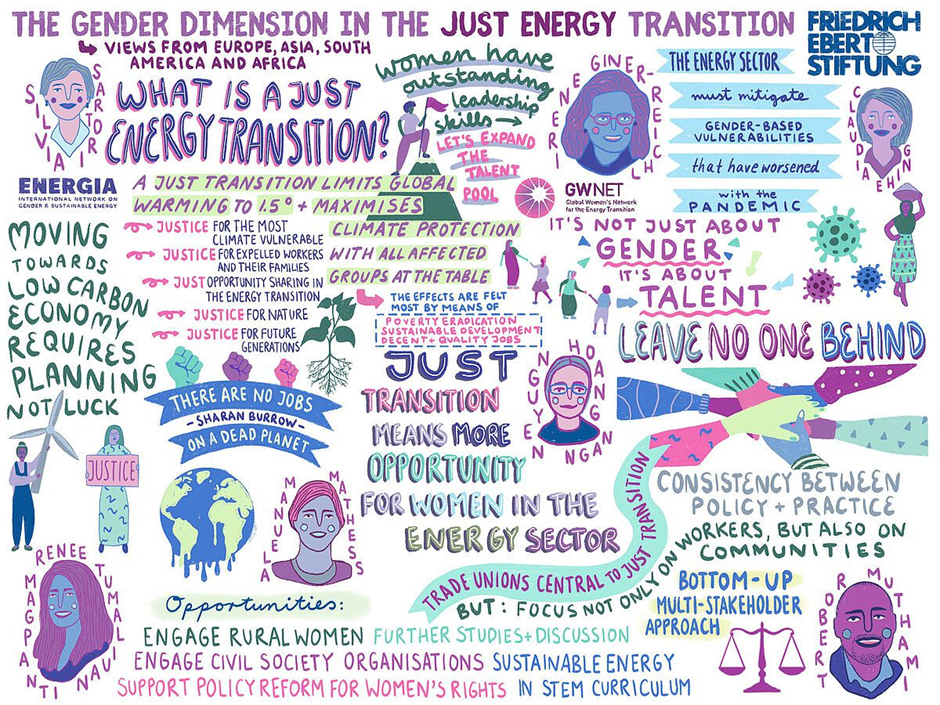
More recently we added the adjective just to replace renewable so that we have the just energy transition (JET). Of course, we want the energy transition to be just but there are any number of nice adjectives that can be added to the renewable energy transition. The featured image suggests we need to consider a gender just energy transition (GJET). Who could argue with that? What about an LGBTJET or a BLMJET? Should we, perhaps, just stick with RET and focus on that rather than all these other more complex acronyms? Alternatively, we can let social science and HR departments deal with that in extended workshops where one sings Kumbaya a lot. If they serve free draught carbon neutral craft beer at the workshop’s engineers like me will willingly attend.
How well is humanity dealing with just energy transition? In this respect, I highly recommend the perhaps over the top satirical Netflix movie, “Don’t Look Up”, where humanity must contend with imminent annihilation from a massive comet strike on earth. I think this movie can be viewed as a thinly veiled metaphor for how we are dealing with the climate change issue. The mainstream media has been quite critical of this movie, but a significant part of the satire is about the media, and I suspect they might not like the woman in the mirror. Spoiler alert, this does not end well for humanity, but I laughed out loud several times.
The RET or JET has become extremely topical and political and there are any number of stable geniuses offering their poorly written and ill-informed sound bites on social media and many parts of the mainstream media. There is a flood of announcements of megaproject feasibility studies for poorly thought through projects most of which will not happen and if they do will most likely destroy significant value. It is not a given that the climate change crisis is going to end well for humanity. It’s going to depend on how efficiently and sensibly the RET is implemented.
How do we implement the just energy transition and what do we prioritise? Should we work on everything at the same time? Should we not focus on the easiest things to do with the biggest impact first? The scale of the RET is enormous and it is not an exaggeration to say it is the biggest project humanity has ever embarked on.
There are several big competing concepts regarding how the RET should be achieved and there are going to be winners and losers. I will pick just one for purposes of illustration. What is the role of green hydrogen in the RET? On the one end of the pendulum, there is a rather limited role for green hydrogen for hard to decarbonise areas like fertiliser, chemical feedstocks, and the steel industry. At the other end of the pendulum, there are the green hydrogen fundamentalists who see green hydrogen as the ultimate panacea for the RET encompassing many applications including power system balancing (electricity storage) e-fuels, and fuel cell cars. In a recent blog, I nailed my colours to the mast regarding where I stand on this one. https://ruminantpinkfriday.com/2021/12/24/christmas-eve-ruminations-regarding-a-christmas-grinch-innovation-green-hydrogen-and-the-next-financial-crisis/.
Based on costs and the laws of physics the scales are significantly tilted in favour of electricity and the energy future is likely to be electrical rather than hydrogen except, perhaps, for some niche hard to decarbonize areas.
In a laissez-faire fare free-market economic sense one should just let all of this play out and let the chips fall where they may. I certainly am no fan of central planning, but the stakes are high, and the clock is ticking. As competing ideas evolve and clash it is perhaps inevitable that we will need to go down some blind alleys. One of the causes of the subprime crisis of 2008 was a wall of dumb money blindly piling into the now obvious fallacy that house prices only go up. There is now a wall of (dumb) money for the JET and ESG. Will it be allocated wisely? It’s not a given that it will be. To the extent that a lot of capital is allocated to unviable projects, the JET will be delayed and perhaps significantly delayed. Rationality, the scientific method, and commercial viability are what brought humanity out of the dark ages and are what is needed now.
We live in an interesting time of populism, competing interests, narcissism, sound bites, and social media creating an avalanche of low-quality noise and distraction. For the JET to be successful within a reasonable timeframe it is important that capital is allocated rationally and wisely.
What to do? I can blog but then perhaps I am just bloviating. Ego iustus meientis in ventum? What, dear readers, are your suggestions. What can you do?
Thank you very much for your comments and suggestions and please keep them coming.
Regards
Bruce
 Ruminant Pink Friday