

Aweh dearly beloved fellow Ruminants & Groupies in day 653 of Re-Modified LockDown Level 1 with Alcohol, no curfew, and slowly decreasing Omicron Hysteria.
Period as a semi-retired pensioner: 281 days
I am going to kick off 2021 with some thoughts about the Malthus debate. Thomas Malthus wrote an essay in 1798 on population growth pointing out that population grows geometrically (or exponentially) while food production grows arithmetically. From a mathematical perspective, the geometric growth of the human population is ultimately unsustainable on a finite planet. The science and the maths behind this reasoning is impeccable. It is a self-evident truth that there is a finite number of people that the finite earth can sustain.
Unfortunately, politicians got involved and used Malthus’s ideas to justify social engineering and eugenics with associated cruel and indefensible policies. In the 20th century neo-Malthusians such as Paul Ehrlich’s 1968 bestseller The Population Bomb, which proclaimed that “the battle to feed all of humanity is over”, have tarnished the Malthusian idea. This article by the well-known sceptic Michael Shermer is worth reading. https://www.scientificamerican.com/article/why-malthus-is-still-wrong/.
Shermer points out as countries get wealthier population growth moderates and stabilises and the latest models suggest the global population is projected to stabilise at around 11 billion in 2100. https://populationmatters.org/population-numbers?gclid=Cj0KCQiA2sqOBhCGARIsAPuPK0gNCK4m2Lk6ul63CagKWQldULuW3SF5PSJ-GL7cJx7PWp8lkJR2QOYaAiJgEALw_wcB. The planet can certainly feed 11 billion people and even a glutton can only eat so much food.
So, everything is tickety-boo? Not so fast. Our current political and economic model is predicated on real GDP growth and associated consumption growth. The idea of continuous geometric real economic growth is rather new in human history. https://ourworldindata.org/economic-growth. It is only in the 19th century that we started to see continuous geometric economic growth.
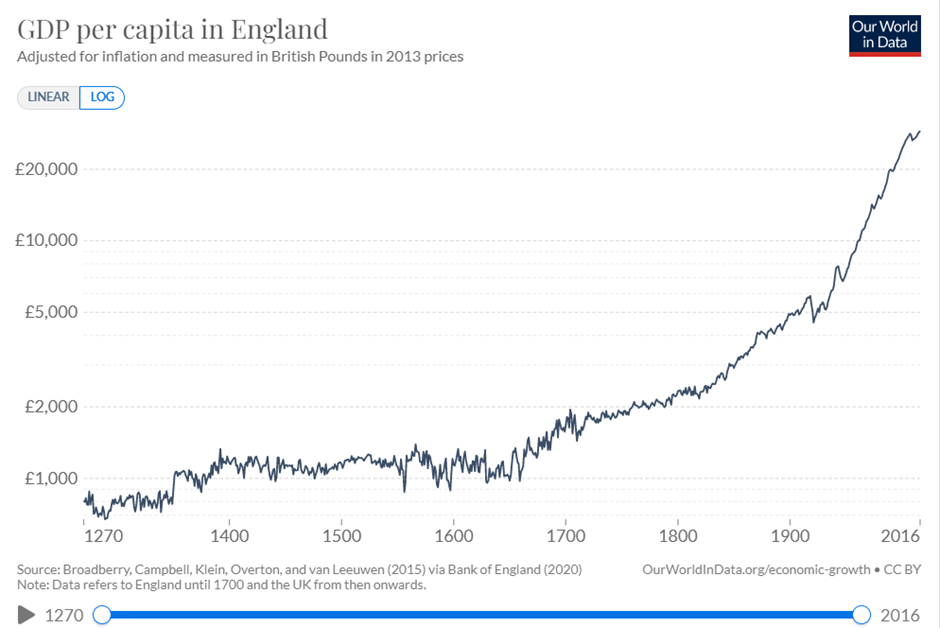
Relative prosperity and a significant middle class is a very recent achievement that distinguishes the last 10 or 20 generations from all our ancestors. From 1870 to 2018 real GDP per person in the U.S. economy has grown on average at 1.67 percent per year with only very short deviations from this very steady trend. Because this trend has persisted for 150 years it is tacitly assumed that it will continue indefinitely. For everyone alive today this is all we have ever known, and it is embedded in conventional economic theory which is also a relatively new discipline.
So, can we project this long-running trend centuries into the future? At this rate (1.67%) real global GDP growth rate, global GDP will be 3.6 times its current level in 2100. By 2200 it will be 19 times and by 2300 100 times greater than today. So, everybody will be rich in 2300? Sounds fantastic. Does anyone have a lightly used time machine for sale?
What does it mean to be rich? It’s not just about money it’s also about consumption. Wealth is associated with consumption. Energy is the master resource and is a very useful proxy for consumption. So, let’s go to my favourite energy guru, Vaclav Smil, and do some Friday rumination. https://www.theguardian.com/books/2019/sep/21/vaclav-smil-interview-growth-must-end-economists.
“You can bring it all down to one figure – it is gigajoules of consumption of energy per person per year, but the unit is not important. Just consider the comparison. The US is about 300. Japan is about 170. The EU is about 150. China is now close to 100. India is 20. Nigeria is 5. Ethiopia is 2. To grow from Nigeria to China is a 20-fold increase just on per capita terms. Such is the scale of the bulge. So, you can cut consumption in Copenhagen or Sussex, but not in Nigeria”. South Africa is like China at 110.
Our culture reveres being rich and associated conspicuous consumption. The featured image is of socialite Theresa Roemer’s walk-in closet which is 3000 square feet (279 m2) to house her clothes and shoes. This is aspirational and admired. https://nypost.com/2020/10/01/socialite-theresa-roemers-texas-home-with-uss-largest-closet-sells/. Surprisingly the article makes no mention of how much of the 3000 square feet is allocated to her husband and it appears to be none. So much for the oppressive patriarchy. I suspect that her energy consumption may be 10 or even 100 times more than the US average. Does this matter? I certainly have no axe to grind with her. However, energy, including renewable energy, has an environmental footprint. At some point, we bump into the fact that the planet is finite. What will the global per capita energy consumption be in 2100, 2200, and 2300? Consumption cannot continue to grow exponentially on a finite planet. 100 times current energy consumption in 2300 is not feasible. Even if you can somehow justify this then you have 523 times in 2400. The trend of the last 150 years will have to come to an end at some point.
The physicist Al Bartlett correctly pointed out that the term sustainable growth is an oxymoron. He suggests the “inability to understand the exponential function” as the “greatest shortcoming of humanity. He has a point although I will say we have many other serious shortcomings. https://en.wikipedia.org/wiki/Albert_Allen_Bartlett.
Let me assure you that I am no left-wing socialist but in the end, the numbers and science transcend politics and have no interest in political ideology. Heavy-handed government intervention is also not the best answer. I certainly need economic growth and good returns on my investments now that I am retired. None of this changes the fact that we are going to have to face up to the fact that exponential growth in consumption is not sustainable over the long term. Stuff will presumably become (a lot) more expensive to limit consumption.
This is not really a doom and gloom story. Many people consume far more than they need. Theresa Roemer has way more clothes than she needs, and she is probably not capable of wearing all her outfits and many of them are just sitting in her closet gathering dust. Age has also caught up with the Roemers and their children have left the house which they have sold to downsize. What will happen to the clothes collection now? Will they go into storage or be sold for a small fraction of what they cost?
In case you think I am uniquely virtuous in this respect I am not. Capitalism has been kind to me. As one does, I have also accumulated a lot of stuff that I don’t need. Getting rid of the junk that I don’t need is a very tedious chore that is not at the top of my priority list and there is stuff in our storerooms and garages that I have not touched for more than a decade and is just gathering dust. It has little value. Note to self, perhaps this is something I should tackle in 2022.
In 2003, when I was 42, Nerine and I were held up in our house for 3 hours. All my clothes were stolen, and I was literally left with the clothes on my back. We were insured but as is often the case and indeed by design, we were underinsured. I bought new clothes and I probably had about a third of the clothes I had before the robbery. I didn’t notice the difference. Perhaps this is because I am a fashion philistine, but I suspect even Theresa Roemer is going to be just fine with a downsized wardrobe.
The person with the most toys when they die does not win. In fact, toys are needy, require maintenance and demand your attention. There is limited fun in allowing your toys to rule your life. There is a deep historical tradition both in the eastern and western traditions of frugality, living within your means, and a contemplative life. So, I ruminate! To ruminate is to be.
Thank you very much for your comments and suggestions and please keep them coming.
Regards
Bruce
 Ruminant Pink Friday
One thought on “Ruminations Regarding Sustainable Economic Growth, Oxymorons, and the Malthusian Debate”